



Charles Melcher, founder of Future of Storytelling, has released an incredible overview of immersive experiences in the form of the book The Future of Storytelling: How Immersive Experiences Are Transforming Our World.
The book, which released last Fall, combines Melcher's insight as the well traveled founder of FoST, which has been gathering pioneers in all forms of storytelling since 2012, with his publishing expertise as the founder of the imprint behind works as diverse as Al Gore's An Inconvenient Truth and J.J. Abrams' experimental experiential book S.
With those two sides of Melcher's experience fused together, readers are left with a highly visual, richly detailed exploration of what immersive experiences are, how they work, and who has been making the most cutting edge work of the last decade.
No Proscenium is proud to present the following excerpt which kicks off the book's first chapter "The Future of Storytelling Is Agentic," that details Melcher's experience with the seminal VR experience CARNE y ARENA, directed by Alejandro G. Iñárritu and realized by the wizards at Industrial Light & Magic.
We're also please to let our readers know that we are giving away one copy of The Future of Storytelling to a member of our audience. You must be either a NoPro subscriber, member of our Discord, or follower on one of our various social media accounts to qualify – so entry is free – and can be done via this AirTable form. (Open to U.S. residents only.)
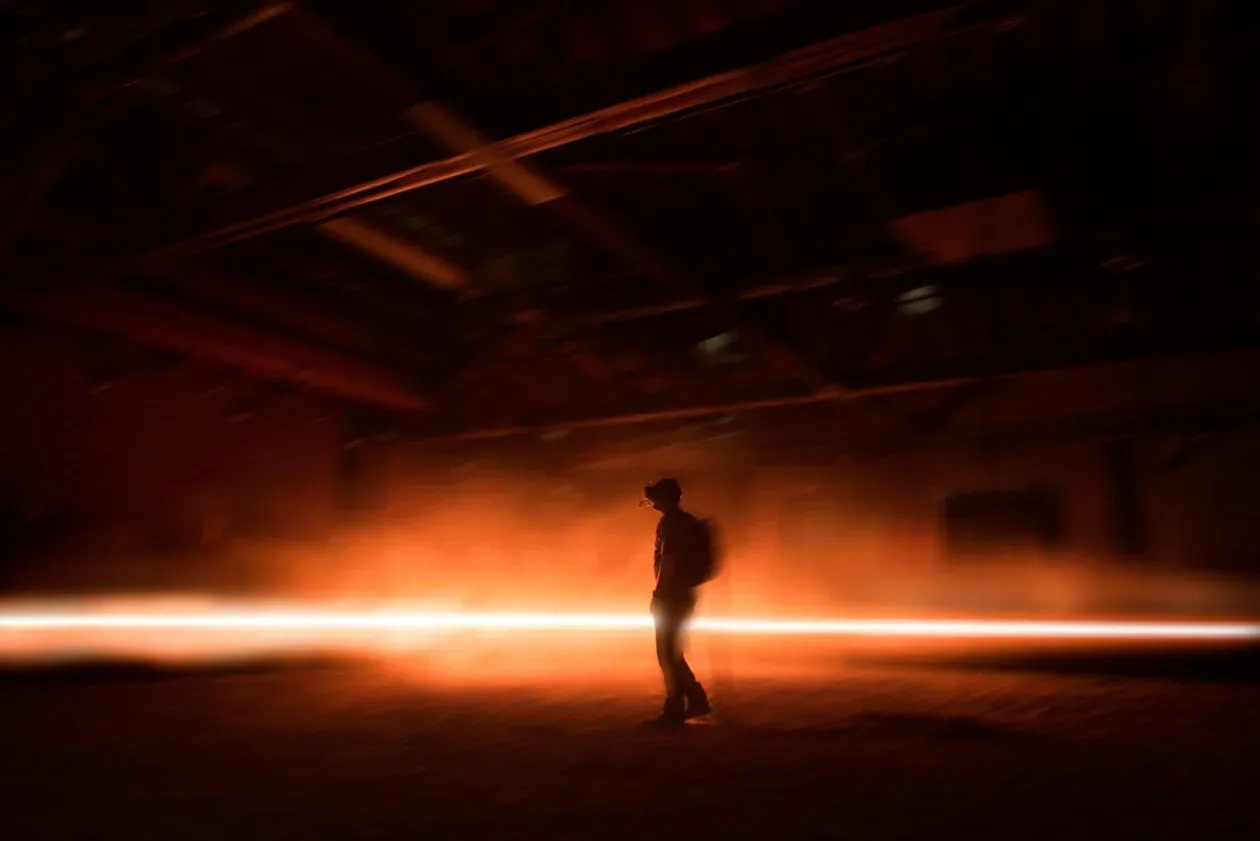
It was February 2023, and I was in the desert. The sand of the desert floor was cold beneath my bare feet. It was just before dawn, and the glow of the coming sun mingled with the purple night on the horizon, framing the nearby shrubs and rock outcroppings in silhouette.
The air was alive with the chirps and whistles of desert birdsong, but otherwise, I seemed to be alone—until I caught the sounds of hushed voices, slowly drawing nearer, off to my left. I turned to see a small group heading toward me; I could catch just enough of their speech to know it was Spanish. As they approached, I made out several faces: men of various ages, women with downturned eyes, children in their arms and at their legs. The group moved with exhaustion, staggering, some limping. Many, like me, were barefoot.
As I watched them pass, I noticed a faint whirring in the distance. Before the sound had even fully registered, a helicopter appeared in the sky above, its spotlight blinding; then there were trucks, too, and from the trucks came men in combat gear, pointing rifles at the group of people, screaming at everyone to get on the ground. The coyote, they shouted over the chop and rushing wind of the copter blades, where is the coyote?
I naively believed that whatever was going on did not include me. I wasn’t part of this group, just an observer who was clearly in the wrong place at the wrong time. As far as I could tell, nobody even knew I was there. But then the guns swung in my direction, and that sense of separation vanished. Before I knew it, there were two or three men on me, staring me down with the muzzles of their rifles. Get on the ground! NOW!
In that moment, the boundary between fiction and reality collapsed. It didn’t matter that I was standing in a warehouse in Northern California wearing a VR headset, that the desert and the Spanish-speaking group of migrants and the military men and their weapons were all a fabrication. There was a gun in my face, and I had to make a decision.
I got on the ground. My hands met the cold, gritty sand of the desert floor.
What I experienced in that Bay Area warehouse on that February evening was Alejandro González Iñárritu’s brilliant VR installation, Carne y Arena. The piece is based on the real lives of Mexican and Central American refugees and their attempts to cross the Mexican border into the United States, but the script is ultimately a work of fiction. Intellectually, I know this. When I recall the memories of that night, and the emotions it stirred, however, I’m not so sure. The second those border agents came at me, I felt wildly unsafe. My adrenaline surged. When I dropped to the ground, it was not play-acting. It was survival instinct. I was truly terrified.
Up until that moment, I had been working under the comfortable assumption that I was invisible, as I have so often been while on the receiving end of a story. I was a member of the audience, not an actor, not a migrant, and certainly not the coyote—as such, my role was supposed to be that of a passive recipient.
All that comfort disappeared in an instant. The Border Patrol officer was staring at me. The face his gun was pointed at was mine. And when you have a gun pointing at your face, inaction is not an option. I had to make a choice. I chose to drop to my knees.
The radical shift that occurred in that moment is that I was given agency. Carne y Arena was not the first story experience I’d had that provided me with agency, but it was one of the most impactful, in part because that agency came as a surprise. In most of today’s VR experiences and live immersive productions, you’re either a participant or you’re not, and it’s generally made very clear up front which is the case. But Iñárritu made a specific choice to surprise viewers with their own involvement. This worked well as a reflection of one of the themes of the story—human struggles anywhere concern humans everywhere—but it also worked as a meditation on our current cultural moment in storytelling. We, the audience, are being invited more and more to step directly into the stories we receive.
Possessing agency is a profound change in how we as an audience experience storytelling. For much of modern history, the most the audience was able to do to interact with a story was clap or boo or perhaps throw cabbages (and even then, only in live theater). Giving us true agency—the power to make meaningful choices within the story environment—is a relatively new phenomenon, and one that transforms the nature of the audience itself. In an agentic story experience, it could be argued that there is no audience at all: By taking an active role in the unfolding story, the group that in traditional terms would be called the audience becomes something more akin to a troupe of actors, or even storytellers themselves.
Discover the latest immersive events, festivals, workshops, and more at our new site EVERYTHING IMMERSIVE, home of NoPro’s show listings.
NoPro is a labor of love made possible by our backers. Join them today and get access to our Newsletter and Discord!
In addition to the No Proscenium website and our podcast, and you can find NoPro on Bluesky, Facebook, LinkedIn, YouTube, Instagram, and in the Facebook community also named Everything Immersive.


Discussion