



The first thing you have to understand about Refik Anadol Studio’s Dataland is that the artists and engineers at the studio have been using algorithms to make art since before it was THE major controversy of the day.
Anadol’s work over the past decade has used both custom algorithms, granted datasets, and the work done by Google’s researchers to visualize data in aesthetically compelling ways. The work, so far, has not been about generating clones of other artist's styles, making deep fakes which can stand in for Hollywood productions, or replacing any already human-made art. Indeed the data they’re using isn’t scraped and stolen, but used with permission. It’s also not the kind of data we think of when we think about AI art. It’s things like environmental data that’s then given a form that can be understood as something other than disparate numbers or the narratives we can weave out of them.
That form has taken shape in the past as large scale projections and what could best be described as digital sculptures. Installations have included the large scale Machine Dreams - Biophilia at Google’s Mountain View campus and the performance Living Architecture: Casa Batlló which mapped onto one of Antoni Gaudí's masterworks in Barcelona in front of thousands of spectators. In other words: Bored Apes this is not.
An argument can be made that the Refik Anadol Studios’ work, while still utilizing tools like Google’s Gemini models, is of a different category than the AI-slop that pollutes the Internet these days. Much of which can be chalked up to good old artistic intent, which honestly doesn’t get enough consideration in the pop culture discussions about computers and art. After all, digital retouching, Adobe Photoshop’s repair tool and Open A.I.’s flash in the pan Sora exist in a continuum of computer graphics processes.
The Studio’s work exists along the same continuum, albeit on their own rarefied branch where the aim isn’t to replace human art but instead to make machines express themselves through art we can feel, and as per Refik Anadol and his partner and Dataland co-creator Efsun Erkiliç’s statements at an invited preview a couple of weeks back: have that art feel us back.
THE EXPERIENCE
The small lobby to Dataland at the Frank Gehry designed The Grand LA on Grand Avenue in downtown L.A. features a video wall reporting in with various bits of data related to the current exhibition Machine Dreams: Rainforest. This space is practically a vestibule, with almost reflective black floors and floor to ceiling glass windows and doors that show off the data wall to the courtyard outside. Indeed, we were made to wear little booties – I always think of them as "crime scene" booties – on our feet to keep from wrecking all the surfaces we'd be stepping on.
To one side, out of view to the public, is the door to the Discovery Portal, a black room lit by a series of twenty monitors synched to display the welcome reel. In front of each display is a case with a seam down the center. After a short welcome message and instructions that case splits open to reveal a scent collar and a wrist sensor.
This is where “the art feels us back” comes into play.
The wrist worn device will track our movement through the galleries, our heart rate and galvanic response. This in turn gets interpreted and then averaged with the data of other guests to influence the work, particularly in the Sanctuary which is one of the last galleries encountered at Dataland.
The scent collar uses different combination of catalysts to mimic various scents found in nature, which synch up to the works in the different galleries. As these things go it’s a subtle touch and the chemical notes that always accompany such devices feel like they’ve had their corners sanded down. By using collars instead of room diffusers Dataland can theoretically tailor that level of the experience with more fidelity for each user, although to be blunt: it might be too subtle to make a heavy impression. On the other hand, for those with sensitivities it may be too much. The devices did not appear to have the equivalent of a "volume" control.
After the Discovery Portal it’s through a door and a few short steps to the escalator down into the Data Pavilion.
DATA PAVILION
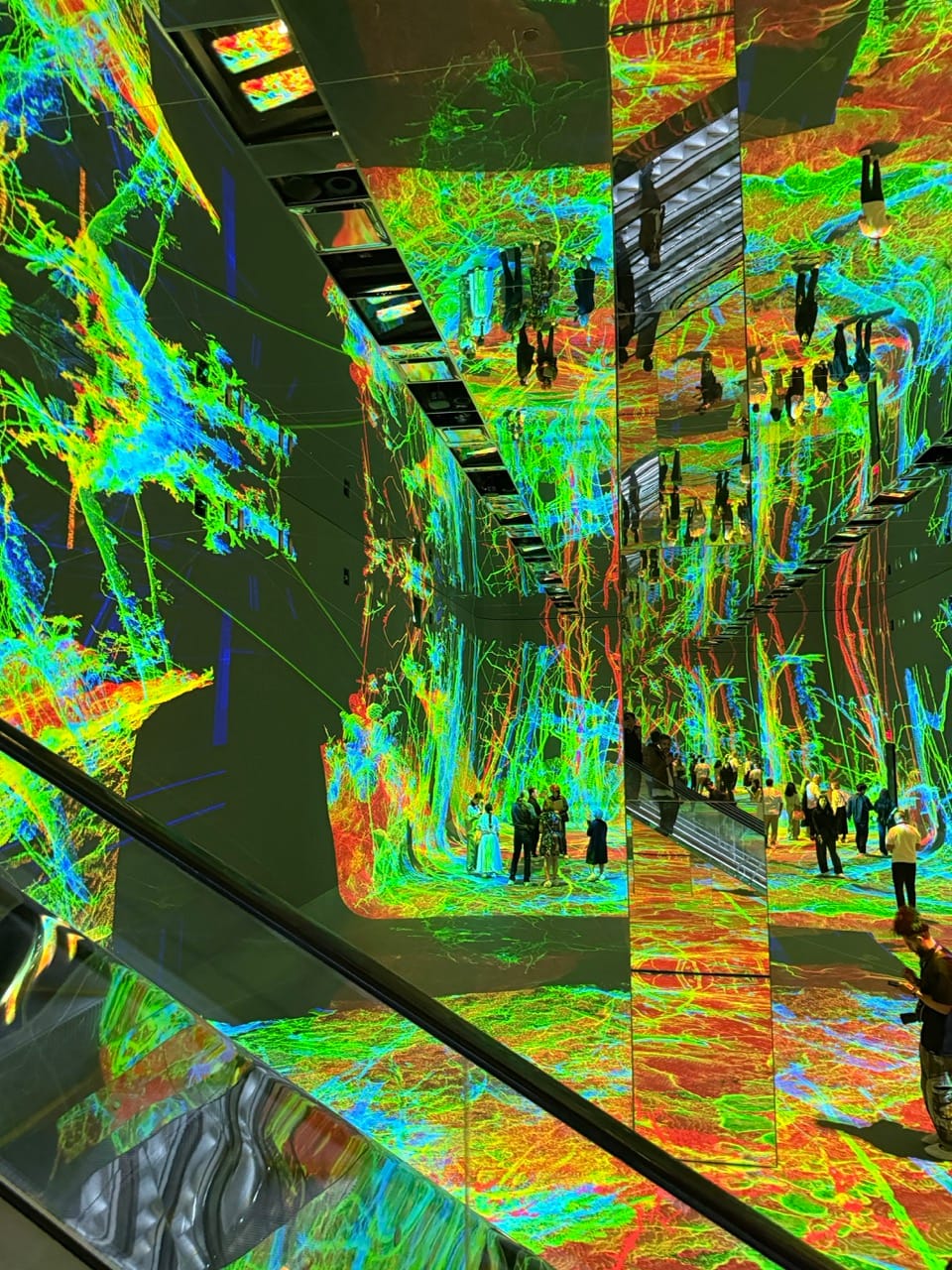
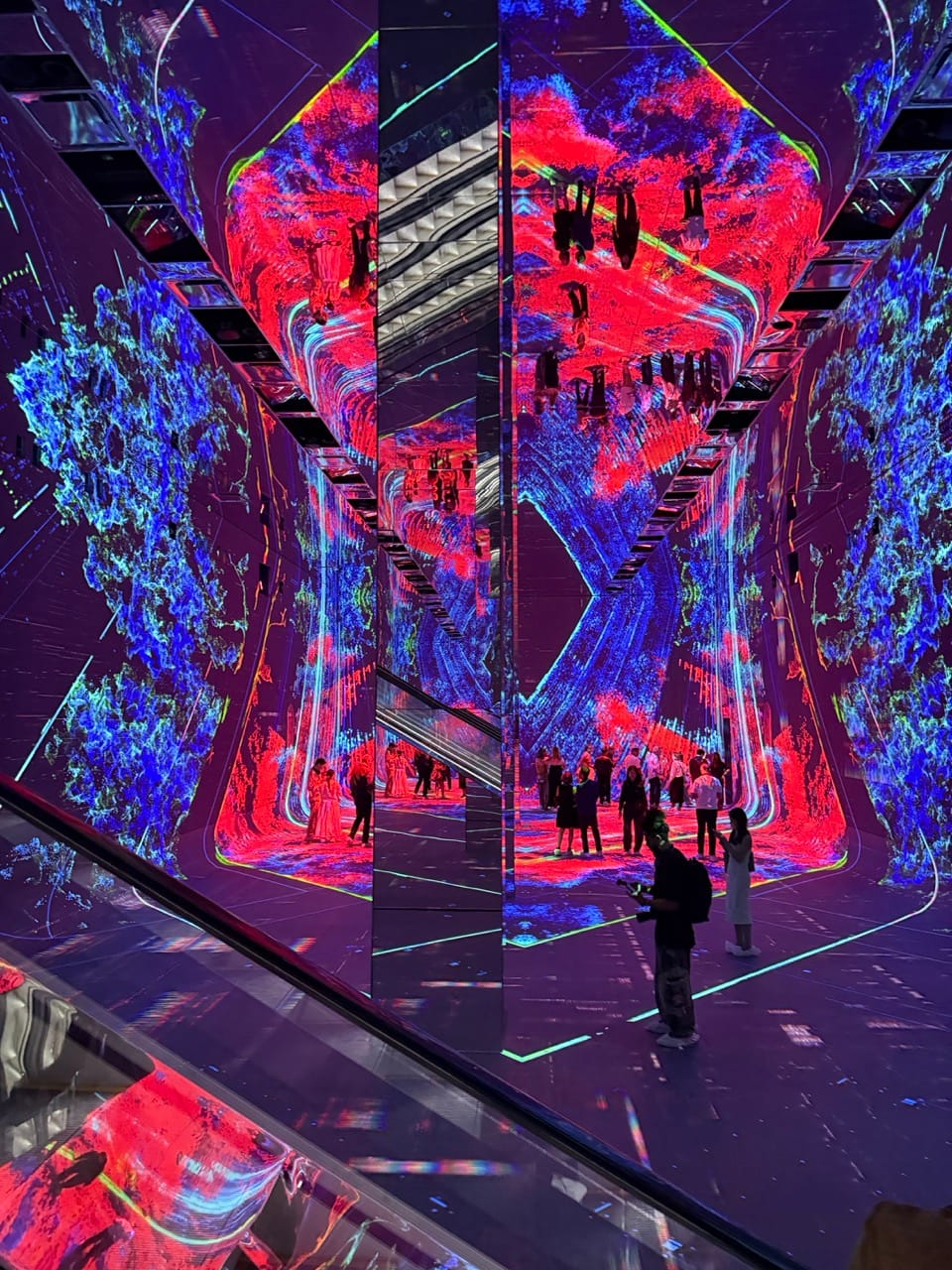
Photos: Noah J. Nelson for No Proscenium
By sheer volume and kinetic intensity this is the star of the show: a multi-story floor to ceiling projected gallery that pulses with visualizations of the Large Nature Model (LMN) dataset that is the crown jewel of Dataland’s archive and which at times responds to our presence by mirroring abstract silhouettes of our selves on the walls. Here you can see your impact on the space in the most direct form.
At times the imagery is almost violent with its pace of change. It’s bracing, but in the way that a cold plunge is bracing. Indeed it was here that I felt most present in the whole of the museum, conscious of this being a work on par with that of the legendary TeamLab whose space in Singapore remains a cherished memory. That said, I wouldn't recommend this to those who are at risk of seizures due to visual stimuli.
If you go my suggestion is that you linger here as long as possible. I took off after not too long, in part to get away from the group I had been loaded in with who had been getting on my nerves. I was set on not hitting the rest of the space glued to their hip, but this was not the move. The move would have been to wait them out. I could have used another twenty minutes here, as opposed to the seven I gave myself. (The recommended time is 30.)
LATENT GALLERY
After the Pavilion comes the Latent Gallery, which in truth is a holding area with three interactive pieces which let you play with the dataset before hitting up the Infinity Room or the Sanctuary, the other two main attractions.
The interactives, at least on preview night, were on a timer before resetting. This gave us only a few minutes to mess around with the archives and creation tools. It’s possible those timers can be tweaked based on throughput — we are talking about computers here — but even then these felt more like snacks than proper dishes. The presentation — transparent plastic screens for the control surfaces set back from the three screens that dominate one wall of the gallery — feels like something out of science fiction and is very satisfying to play with. What felt missing was the ability to impact the room as a whole while we summoned up audio files or finger painted plant textures with light.
Less futuristic were the queues for the Infinity Room and the Sanctuary, which on preview night meant standing in a line, one of which backed up into exit from the Pavilion. It wasn’t clear if maybe the intended system for the event that night had broken down — we all had different color wristbands, but that didn’t seem to impact anything — or if the plan is just to let people line up in the Latent Gallery.
Depending on how many people are in the overall space — and it was noted to us that the groups were oversized that night — the experience of the Latent Gallery can turn into that of just a big mass o’ people waiting in line and yapping. If the intended pace during normal operations of 20 people every thirty minutes holds, with some crossover between groups, then we're on to something that will feel elevated.
INFINITY ROOM
Video: Noah J. Nelson
The Infinity Room takes the idea of the mirrored art room and turns it into an authored video installation clearly inspired by Yayoi Kusama's storied physical installations, two of which are on display at The Broad across the street. That is before transforming into something almost like a thrill ride. This was the next space I hit up, a path suggested by the space itself — the Infinity Room is right there when you come out of the Pavilion — and in terms of vibes I think it was the right choice.
The currently on display piece is The Dream of Ruwe Pinu, which does the deepest literal visual dive into the rainforest of any of the material currently running. It’s stunning, if not quite as all encompassing as the Pavilion.
One odd thing about my experience in the Infinity Room is that no one moved. All the video I’d seen before — and since! — showed people moving about and getting up close to the video walls. This was even implied in the promo shots.
But the piece starts in the darkness with a series of circles on the ground — we’re standing on video monitors, so thin heels aren’t allowed — which are there to keep us from bumping into each other in the dark. They fade once the video has started.
Only the group I went in with didn’t move after the video started. As I was in the back row I didn’t feel like pushing past to start a scramble. Nothing told us we could or couldn’t move, save for those circles. I stood there through most of it trying to think of how they could let people know they are allowed to move. Unless of course they aren’t supposed to. But that can’t be right. And the thing about those circles is I’m going to be that half the time people just stick to where they were “assigned,” and that makes for a subpar, and seemingly unintended, experience.
THE SANCTUARY
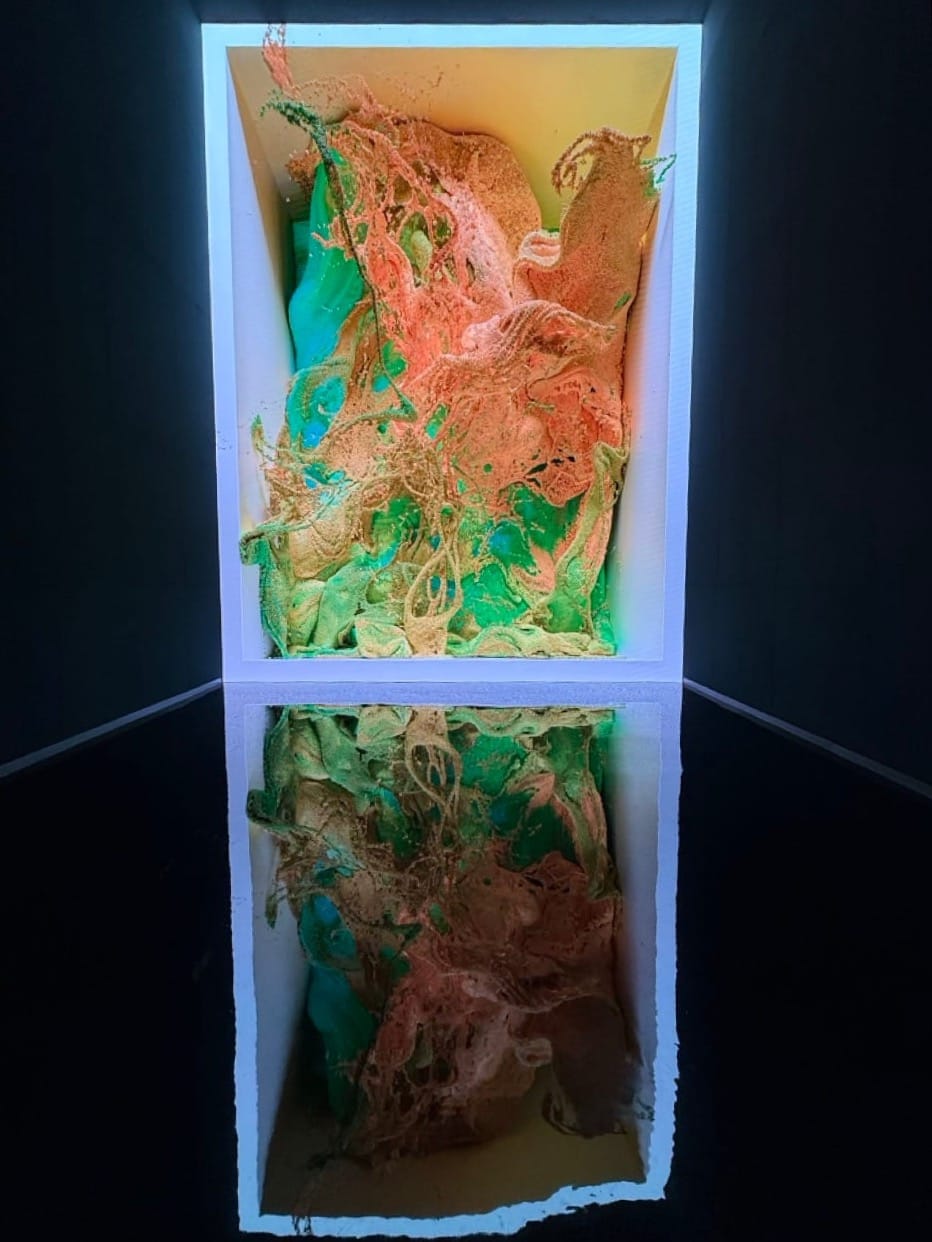
The final main attraction is The Sanctuary, which features a humongous multi-story screen. Think real IMAX, maybe bigger. Conjured onto that screen is a sculptural piece that is an expression of the combined data of the people in the room, which can been seen in graph and chart form on a screen set on the back wall.
Aesthetically the visuals are beautiful, a truth only slightly diminished by the people who ran down in front of the big screen to have photos of themselves in front of it taken. (Hope you like silhouette shots, people.)
Digital works at this scale — this one had the properties of a living wave made of thousands of small balls inside a box — activate a part of my brain usually reserved for really tall trees. It’s a strange, almost synesthetic effect I experience when an installation is really good and that vibe was present here. Photobombers not withstanding.
Taken as a set the three main attractions of Dataland are certainly bold, and make a nice companion to the works on display at The Broad one crosswalk away.
The question I have is about the pricing.
The Value Prop
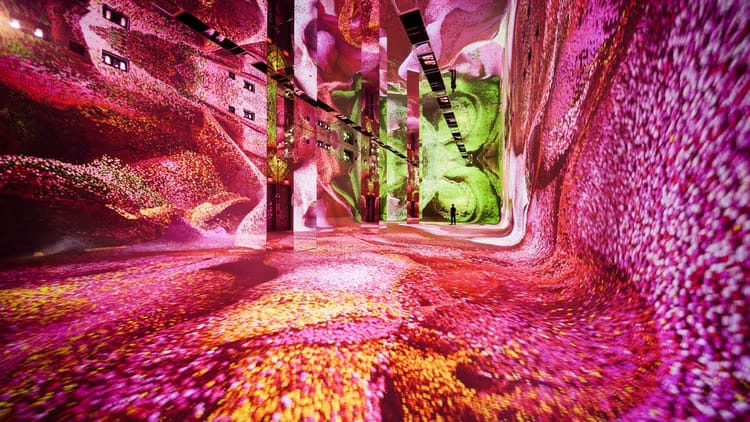
Off-peak weekday starts at $49, which feels a little pricey given how tight the economy is for the vast majority of people these days but not unreasonable if the latest digital art is your thing. By comparison TeamLab goes for around $30 in Tokyo and SuperBlue in Miami goes for about $44 when you add in the TeamLab exhibit. So call it “an L.A. tax” for that $49 price.
But that’s the off-peak, weekday.
Weekend on-peak hits a high of $79.
That’s a lot. Now maybe the fact that only 20 folks at a time are allowed in on the half hour will make the critical difference in terms of experience. And at a max of under 500 visitors a day at the current pace, the ticket price isn’t going to be able to be $30 and have this turn a profit, which as a commercial endeavor it needs to.
The setup allows for new exhibits to come through fairly easily, which will be key if Dataland can wow enough folks to become repeat visitors. Right now the spectacle is going to have to drive the business, because while the sensors and the customization are technically there, the overall effect feels less responsive to our presence than it does interpretive of our data.
Ok, that’s a kind of response: but an intellectual one. The work seems to be aiming towards the question “what does all this Large Nature Model data feel about our presence?” How does that reflect our impact on the world as a whole? There’s a correlation to be dialed in here, and the challenge for Dataland will be making people feel these connections.
It's not an impossible task, as art studios – like the aforementioned TeamLab – have been using interactive tools and digital art to create lasting emotional impact for some time now. It's also no knock to be compared to TeamLab while debuting one's first single-studio museum. But make no mistake: it's a challenging standard to live up to.
Dataland, from Refik Anadol Studio, has opened at 100 S Grand Ave in Los Angeles. Tickets are $49-$79.
Discover the latest immersive events, festivals, workshops, and more at our new site EVERYTHING IMMERSIVE, home of NoPro’s show listings.
NoPro is a labor of love made possible by our backers. Join them today and get access to our Newsletter and Discord!
In addition to the No Proscenium website and our podcast, and you can find NoPro on Bluesky, Facebook, LinkedIn, YouTube, Instagram, and in the Facebook community also named Everything Immersive.


Discussion