


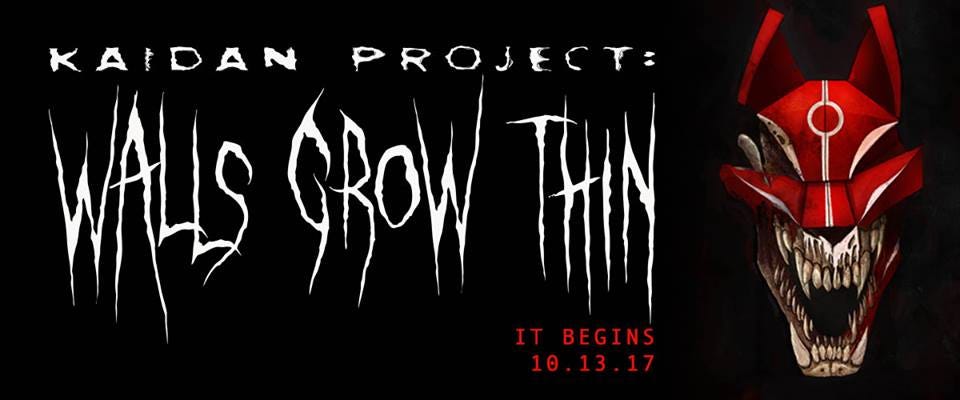
Rogue Artists Ensemble has been creating unique, critically acclaimed, multimedia theatrical experiences in the Los Angeles area since 2001. For the next month, they will fill a 10,000 square foot warehouse with their immersive take on ancient Japanese ghost stories, Kaidan Project: Walls Grow Thin.
We spoke with Sean T. Cawelti, artistic director of Rogue Artists Ensemble and director of Kaidan Project: Walls Grow Thin, over email about audience involvement, puppetry, and the evolution of this show throughout its long development process.
No Proscenium: For those who don’t know Rogue Artists Ensemble, could you give us a quick breakdown of what the company is about?
Sean Cawelti: Rogue Artists Ensemble is a collective of multi-disciplinary artists and storytellers with a keen eye towards how design interfaces with text to create highly immersive experiences for audiences. We create ‘Hyper-theater,’ a mashup of old traditions such as mask work and puppetry combined with newer technologies such as media- and technology-based storytelling platforms.
We formed as a not for profit in 2003 after having worked together for several years on the campus of UC Irvine where the founding members were undergrads. We have a commitment to home brewing our original work in Los Angeles. And as an itinerary organization, our performances often take place at both traditional venues and more unconventional found spaces.
NP: You’ve been developing Kaidan Project: Walls Grow Thin for some time now. What have you discovered throughout the process?
SC: We have been working on what has evolved into Kaidan Project: Walls Grow Thin for over 5 years. The project has morphed many times along the way. Earlier iterations of the project took place in less controlled environments such as the beautiful Japanese Garden in Van Nuys. It was the garden workshop in a public space that led us to decide upon using controlled environments that were not publicly accessible.
Through this process, we explored different forms of audience involvement and how much or little narrative and information is required. We’ve also been exploring what it means to have an audience in close proximity to puppet and mask characters which is a unique challenge in that it requires some things to be created in a very different way due to this closeness.
NP: Rogue Artists Ensemble is partnering with East West Players for this project. How did this relationship develop?
SC: Rogue started discussing a possible co-production with East West Players several years ago with their former Artistic Director Tim Dang, who was incredibly supportive of the idea and encouraged its development. We have had several readings that members of East West Players attended and the dialogue between the two organizations has been tantamount to the project’s development. Both Rogue and East West Players, now led by their new Artistic Director Snehal Desai, are keen on illuminating stories and perspectives that are not often shared. Kaidan Project: Walls Grow Thin is a wonderful example of that passion realized.
Get Karlie Blair’s stories in your inbox
Join Medium for free to get updates from this writer.
SubscribeSubscribe
NP: What’s your approach to creating immersive theatre?
SC: Rogue Artists Ensemble has been exploring the audience and performance relationship since the organization’s inception. You won’t often find a stable 4th wall in any Rogue show as the line between performance and audience often blurs and morphs. Each production that Rogue has developed has specific rules governing the audience and performer dynamic and this often even changes from character to character.
For each moment of a story as the script is being created we reflect on the method for telling that particular moment of the story. Is a puppet used? If so, why or why not is it the best choice? We often also look at what the ask from the audience is in terms of involvement and how much agency the audience has. For our production of Wood Boy Dog Fish last year, we blurred the line by having the audience wear 3D glasses so that the elements from the show leaped off the stage.
For Kaidan Project: Walls Grow Thin we have been looking at how to take a more structured narrative and involve the audience as characters. We have been workshopping the ability for us to have duplicates of certain characters that would travel with the audience through the entire journey and remain constant even though the audience may be moving throughout the space. The result is that we are able to tell a narrative with a more sophisticated arc with a greater emotional resonance.
NP: You do a lot of puppet-based work. How did the company’s interest in puppetry start and how has it informed your work?
SC: The puppet and mask integration within the Rogues comes from my childhood. I received my first puppet when I was three years old. From that point forward I became fascinated with the way a puppet can help articulate a story. Each Rogue project has incorporated some degree of puppetry and object manipulation; much of the company’s exploration and research has centered around the how and why.
Puppets are incredibly sophisticated storytelling devices and, when used properly, can impact on an audience on a deep emotional level because of the object’s ability to channel a powerful feeling of pathos. Often times the conversation of puppetry use happens before the script is even completed, so for most Rogue projects the puppet and storytelling conventions become baked into the DNA of the piece at an early stage. For us, the way we are telling the story is a world-building tool and critical to the success of a piece.
NP: What can folks expect from Kaidan Project: Walls Grow Thin?
SC: Kaidan Project: Walls Grow Thin is a highly immersive multi-sensory experience in a warehouse built in 1927 that covers three floors, over 10,000 square feet of space and features twenty-two distinct locations. During the 75 minute experience, a group of 12 will descend in an old freight elevator and begin their quest to help an old friend confront a powerful force. Throughout the experience your group will be divided. You will have the choice to explore areas on your own and participate in a final sequence.
Audiences will find themselves within several Japanese ghost stories and meet some incredible characters along the way, brought to life by a cast of 23 very talented and diverse artists. During their journey, guests will experience awe-inspiring scenes and obscured, sometimes terrifying realities. This show is not for anyone who is afraid of the dark.
Kaidan Project: Walls Grow Thin runs from October 5 to November 5 in a secret warehouse location in the 90019 ZIP code. Tickets are $50 for previews, $125 for opening night, and $65–$75 for the rest of the run, and can be purchased online.
No Proscenium is a labor of love made possible by our generous Patreon backers: join them today!
In addition to the No Proscenium web site, our podcast, and our newsletters, you can find NoPro on Twitter, Facebook, YouTube, and Instagram and in our online community Everything Immersive.


Discussion