



Masquerade is an immersive adaptation of Andrew Lloyd Webber’s musical The Phantom of the Opera. Being the longest-running show on Broadway, Phantom is a cult classic for many musical theatre lovers, but this is not the first to attempt adding immersive elements to a Broadway-scale production.
Recently, New York City has seen Cabaret at the Kit Kat Club, which “transformed” the theater into the Kit Kat Club, a production which lacked a firm understanding of what makes an experience truly immersive. This has proven to be a theme for Broadway’s various attempts at immersive work, but Masquerade seeks to break that barrier. With an immersive powerhouse team backing the endeavor, including Randy Weiner et al, and steep ticket prices starting at $195 per person, Masquerade had a lot to live up to in our eyes.
Both myself and No Proscenium NYC staff correspondent Nicholas Fortugno took to the opera house to investigate. While Allie was a first-time audience member in this production, Nick had seen a preview showing prior to this viewing. I am a Phantom fan (but not a superfan) and Nick is a certified Phantom hater. What follows is our take.
– Allie Marotta, NYC Curator
WHAT IS IT?

Nick
Masquerade is basically a dark ride of a Broadway musical. It's a promenade-style experience where you move through a physical space, including, interestingly in this case, up and down using escalators, from scene to scene, and then you witness the scenes with generally a minimal amount of interaction, but very closely. Obviously, the scenes are very intimate, and they're very stylized with one exception of a pretty robust mini-immersive point where you interact with carnival performers in a not very narrative important, but very interactive kind of sideshow experience.
Allie
So promenade-style, meaning, audience members are guided through the experience. You don't have a choice of where you're going. And you're very specifically guided by lots and lots of docents. They're very particular about where they would like for you to stand or sit throughout the experience.
Nick
Which sometimes leads to a little bit of branching, but not branching you control, and minimal branching with minimal impact. Just like certain people get to see slightly different things.
Allie
But my understanding is, for the most part, everyone kind of has the same content experience. It just might be like flip-flopped, or like you might see one part of multiple things that are happening in the same room.
FIRST IMPRESSIONS
Nick
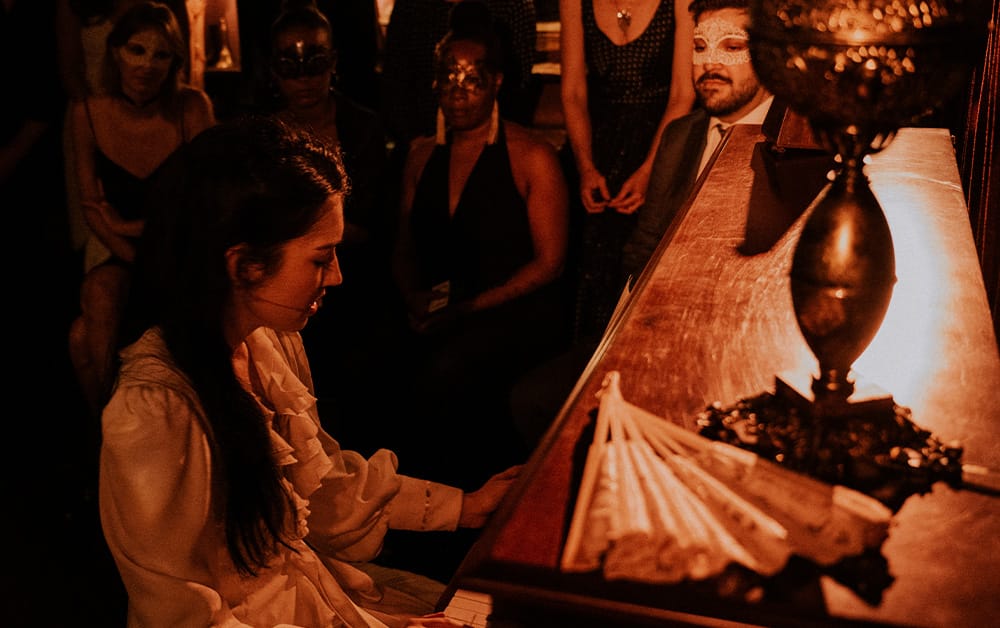
I think Masquerade is phenomenal. I think a lot of your impression of Masquerade is going to depend on your experience, your feelings about Phantom of the Opera. So, if you don't like Phantom, which I kind of don't, I think it's a mixed product. However, it’s a kind of phenomenal use of a particular kind of immersive experience that shows really remarkable stagecraft. It is fascinating to see singers that talented that close. And there is an affordance of this promenade style that I think is really incredible for theatre, that I think points a way forward for this kind of Broadway show that you could make really fascinating work with. And if you are a Phantom fan, this must be a dream come true. To have “Music of the Night” sung three feet away from you while The Phantom touches your shoulder, that has to be mind-blowing for a Phantom superfan.
Allie
I also really liked it! I thought it was fantastic, which is surprising because I've historically said that i don't think a musical can successfully be made immersive because the way that musicals are designed, everybody is supposed to be watching because every moment is important. In a good musical, every song is supposed to be so important that the character is compelled to sing, so everyone has to see it. And there's always been this kind of underlying thought that immersive as a genre is often choose your own adventure, featuring synchronous actions, so you might miss out on one thing because you're seeing something else which is often as a result of trying to problem solve audience to experience ratios: the production needs enough ticket buyers each night to be in the black, but without sacrificing the opportunity for an intimate experience. But Masquerade got around that by creating multiple runs of the full production in one night. So they achieve that more intimate small audience, but they're able to still sell enough tickets because they're seeing multiple audiences per night. And I thought they did a really good job of transposing a musical into an immersive format.
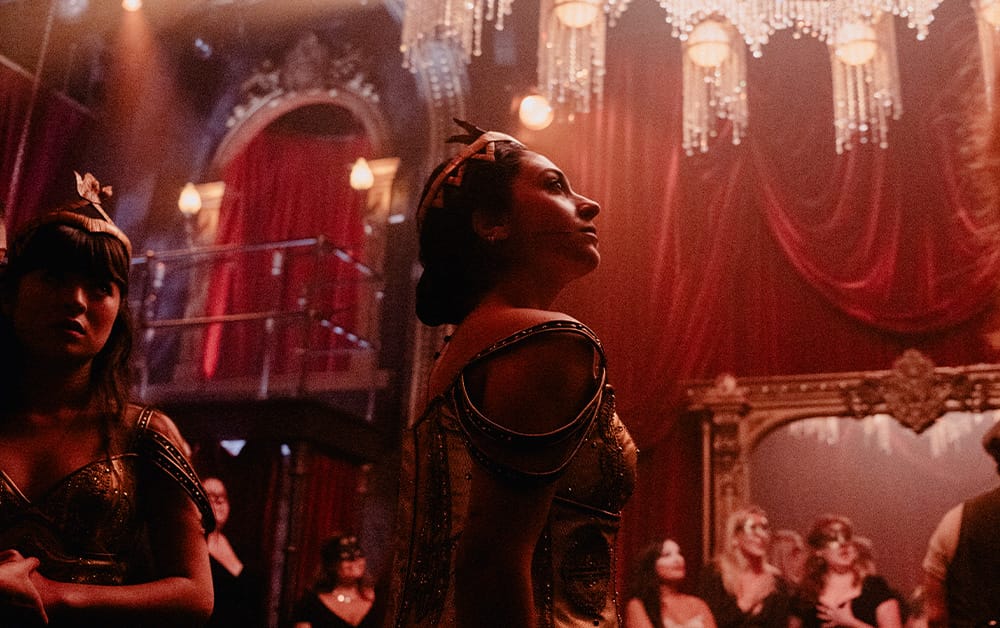
The thing that impressed me the most was the spectacle of everything. There's some actual magic tricks that are happening, which I was really impressed by — they’re really well done. I thought everything looked and felt super expensive, the costume craft is there, the sets feel developed, the space is huge, and they didn't reuse rooms, which was great. You're offered drinks and a mask and all of these little pieces of the experience, which really made me feel like, oh, maybe that ticket price is actually like, correct, which I was surprised by as well.
Nick
In no way whatsoever did I feel like I was ripped off by that show. The show might be expensive, and I might not want to go see it because it's so expensive, but I did not feel like, oh, I got a $100 experience for a $225 ticket. I felt like I got a $225 experience, which is because they made the model in such a smart way that they're able to, in theory, meet their sales quota each night without sacrificing the experiential part of it because they're running it in those staggered groups. And the staggered groups are where the stagecraft is just like, unearthly. I mean, it's like the machine of that. And I know people have said in other kinds of immersive experiences, like haunted houses, you see this kind of flow, but I've never seen it at something at this scale of production value.
And it's really amazing that they are able to pull off these scenes where they have to have audiences split between multiple rooms, and they have to have all of it paced to get to the same scene afterwards. There's just something incredible about how they pull that off.
Allie
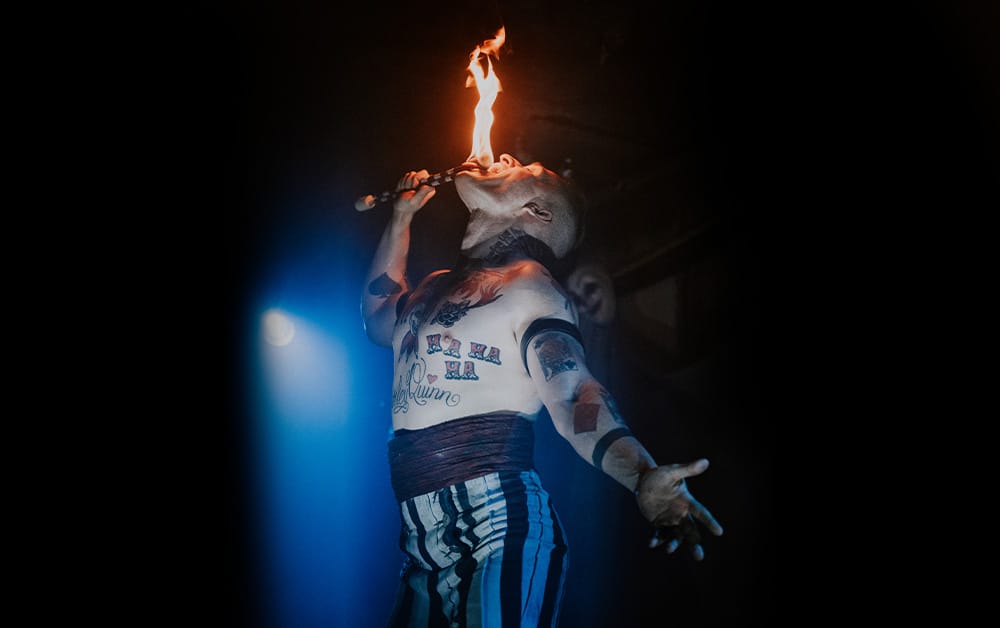
And also the performer aspect of it! I know they have multiple casts for the leads, but I believe the ensemble is rotating back through some of these scenes? And I was thinking about this, particularly regarding the fire eater in the show. Is this performer eating fire seven times a night? Like that's crazy. I don't know how many fire eaters they have.
Nick
I mean, it was the same fire eater I saw in both shows.
SPOILERS AHEAD
Allie
So, it's good because that means that folks are getting a good contract and consistent employment in that way, instead of having to just do one show a night. But I do wonder, for the rigor that the performance requires, how they manage that, and I know this has been a topic of conversation about when they choose to move the outdoor moment to the indoor version. What I’ve heard is that it's actually not just inclement weather, but also if the performers' voices aren't able to safely handle performing outdoors, they might move it indoors.
Nick
That makes sense. I've luckily seen both versions of it. So I can actually speak to both versions, but that makes sense. It occurs to me, regarding the fire eater, that if you go to a Renaissance fair, and you see one of the shows at a Renaissance fair, they usually do two or three shows a day on rotation, and those shows are an hour. So it might not be too much of an ask for a carnival performer to do seven 10-minute shows during the course of a night, but to your point, it is a much better contract, right? Because you're basically being hired for the whole three-hour block.
I want to go back to something you said earlier, though, because I think this is the most important thing. And I think the insight you had, it's in the frame that you had about why this couldn't work with a musical? Or why did we believe it couldn't work with a musical? And I think the logic you gave is really good. The whole point is this song is an outburst of the most powerful thing that's happening in this moment, and how on earth could anyone not see this? It's critical to see this. Like, everyone has to see “All I Ask of You,” right? You can't not see that song. And so what do you do with the audience so that everybody sees that song, but it still feels like you're doing something intimate and immersive-y, right? And I think they did that by using this promenade style. But what really came out magically is that it's not that they corrected for the concern you had, they actually leaned into the form so that it solved that problem in this really superior way. Because I think this is what's so powerful about this piece, is that when you don't change the central stage in a promenade theater, when you go in a different direction, the whole structure of how a scene works changes, right? If you're in a promenade and I have to change the set, like, I'm thinking of like Met Opera level, like the set rises and falls and stuff, right? It means that you have to do the staging with this one perspective all the time. And that is very limiting, I imagine, in how you can set a stage. And it means that the sight lines of the show are always essentially the same sight lines.
And you're always going to have better and worse seats in the experience, but if you take the scenes and you break them up over a very long space and you make them all small, the director could literally just sit in every seat and move it if it wasn't good. And so, I sat in two very different places in the “Music of the Night” scene, and neither of them felt superior to the other. I felt, in both places, if I had just come into that moment, sight unseen, that I was in the best seat I could be in.
And that happened to me in so many places, like in the scene where Christine is at the tomb and The Phantom appears, I was above that scene. Whereas the last time I was on the ground of that scene, although it was outside. And I did not feel like one of those was The View. I felt like, oh, these are both good views of the scene.
Allie
Which tells us that's a good director. But yeah, this idea of like trying to make a musical immersive, I think what Masquerade has that other immersive musical productions I’ve seen fail don’t is a huge budget, and because of that, they are able to move us through space. Because the way I've seen other creators answer this question is that they place the show as theatre in the surround where the audience is seated in one spot the whole time and the actions happens around you. And that doesn't feel particularly immersive or experiential to me. It's missing that like up-close intimacy that Masquerade does have. So I think that is also part of their answer.
But I'm also thinking about the immersive Into the Woods that just happened on Staten Island in a park. And they were able to do it. I don't know what their budget was, but certainly less than Masquerade by using the natural architecture of the park, instead of building out a massive custom space. So it is possible to do it without a big budget. So, regardless, the immersive musical is calling for a lot of space to work in this format, which a lot of creators haven't had the opportunity to do in the past.
Nick
I think that's very fair. And the through line that makes the whole thing make sense is the need for intimacy. It's a different kind of intimacy in a Broadway production, because it's about focusing all of our attention on this one thing and then having it be so remarkably performed that it just takes our breath away. And that's what immersive can do when it's done right is make that intimate in a sort of architectural way. Where we're literally close to it. And having done a lot of immersive opera and not liking opera very much personally, but still realizing that seeing a singer like that is just an incredible experience. Just being that close to someone who can perform that, there's something just really powerful about it. And so you get a similar kind of experience in the sense that I feel like the most important thing is happening in front of me and I'm paying all the attention in the world to it, but I get the intimacy not here from like this sort of funneled vision towards the center of the stage. Instead, I get it from like 30 different sight lines on a single object that are all great, as well as physical closeness. It's super cool to see and to experience.
FAVORITE MOMENTS
Allie
Let's talk about some of our favorite moments while we're on this positive note. What are some of the moments that stuck out for you that you might share with someone who you need to convince to go see it?
Nick
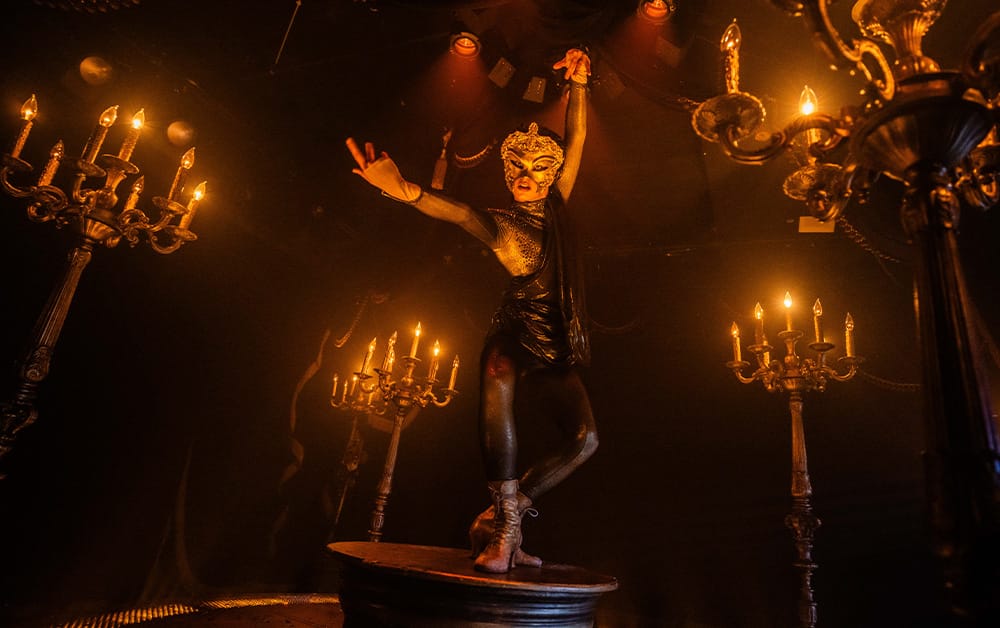
Again, all of this is framed around, are you a Phantom fan or not? If you are not a Phantom fan, why do you go see this show? But for both sides: “The Music of the Night.” It’s incredible. Like they know what they're doing with it. They get somebody who really sings it. It's just a good song sung powerfully in this moment.
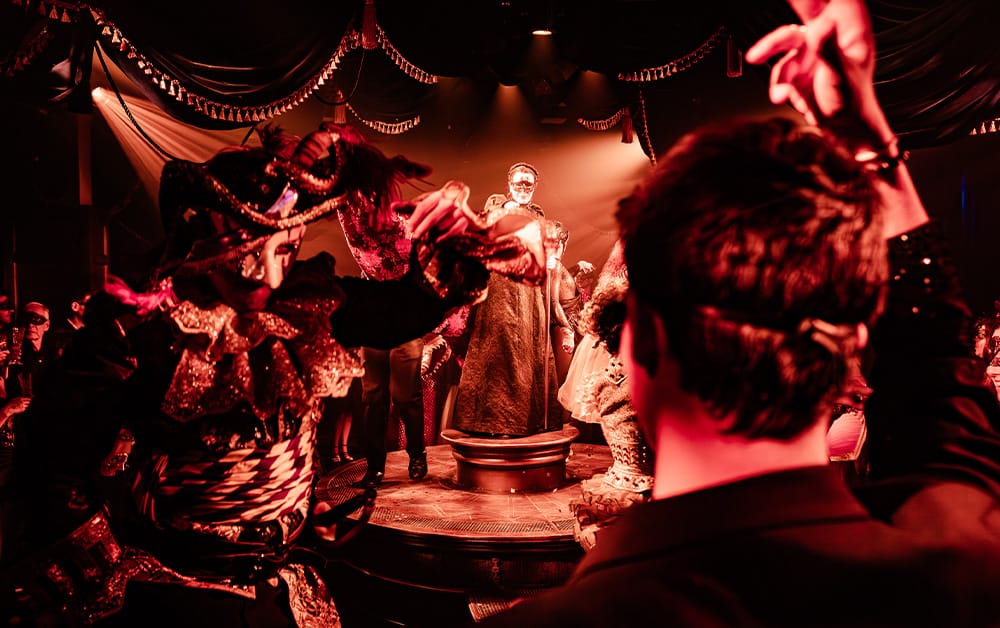
I think the carnival scene is another standout. The immersiveness of that scene, in terms of it being the kind of weird interactive scene that it is, it's just genuinely good. Like if I had just seen that on its own, I would have been impressed by it. Just the feeling of being in a carnival and talking to these people I think, was really good.
Also I think the very end of the show and the magic of the very end is really strong. They take what I think is one of the worst endings in musical history, and they change it into something that actually has power and meaning. So I think that works. And if you do happen to see the outside version, it's incredible. It is like nothing I've ever seen to see a song on a rooftop over New York City. It's just amazing. And it’s not that the inside version is bad. It is certainly not. It is quite good. And it is worth it. But the outside one, there's an aspect to it that just blows your mind.
The one other thing I would say is, there's a set of dressing room scenes where there's a little bit of magic, but it’s essentially four scenes that can be done in any order, where the audience is split into much smaller groups of like 12 or something like that. And then they rotate the scenes through each room. And this is not something that an audience might appreciate, but this is something theatre makers will appreciate. The machinery of it is mind-blowing. And everyone I know who knows theatre keeps talking about that scene and trying to figure out how it works.
Allie
Yeah, they've got it down to a science, which is great to see. There's nothing sloppy about the execution of it, which is why it's so phenomenal. I will add for the indoor/outdoor scenes, if you don't end up outdoors, don't be disappointed because you get to see two rooms that aren't used in the show otherwise, if you're indoors, which is exciting. But I do wish I got the chance to see the outdoor version. I'm definitely going to go back, and I hope I see it then.
One of my favorite moments that you didn't hit on was actually the opening. I loved that after the formal onboarding, there's a moment where it's kind of like a cocktail party. They give you a glass of champagne, or a non-alcoholic option, and you're mingling, and you're listening to a violinist, and it's really lovely. And then that sequence follows, where you get to meet one of the characters, you get a little bit of interaction, you get to do a little bit of dancing, and then, this is a spoiler, suddenly the doors open up behind you. And this was like my show-stopping moment, right at the top for me, because I was right in front of the doors, and they opened up behind me, and I was face-to-face with a performer belting “Masquerade” and it was so magical! I knew exactly what this was from that moment on, and that whole scene is great too. They really set the tone, and there's a lot of festivity to it that felt really special. It’s just a lot of fun. That’s definitely my favorite moment.
Nick
Yes! And I think it's almost this moment of a bait and switch. Almost like they knew we were going to think they weren't going to go as big. And so they gave us a very tasteful, well-executed, simple immersive thing at the top. And then it just opens up to something insane.
Allie
Literally insane. Confetti falling from the sky. Like, I was so bought in when they sing that line, “There's another mask behind you,” I actually turned around to check.
CRITIQUES
Allie
Ok, so to quote Gordon Ramsey, what would you change? What don’t quite work or could use more work?
Nick
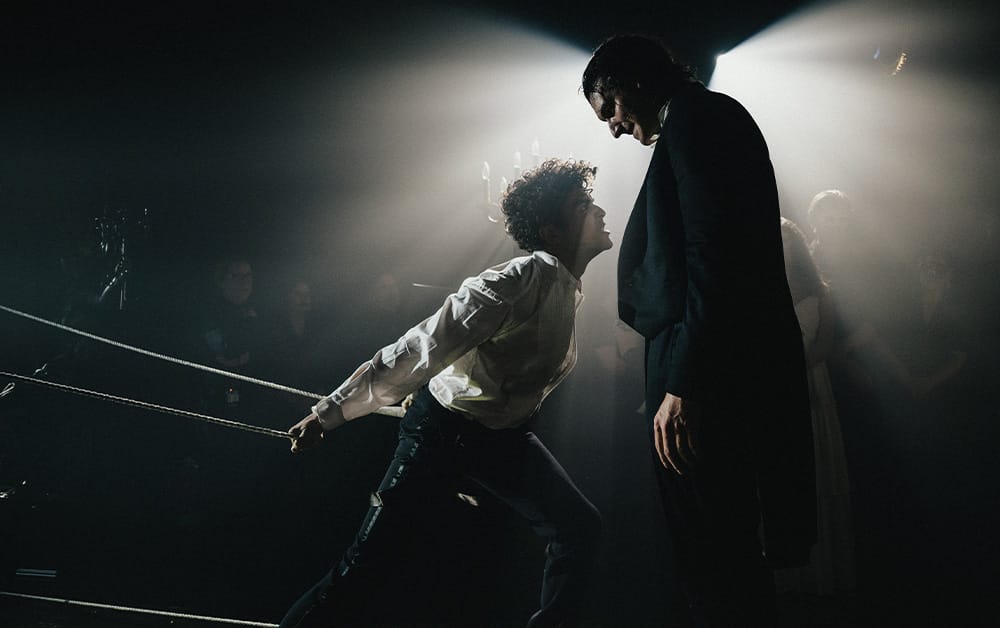
So here's the issue. It's Phantom, right? I know I'm going to offend a bunch of the real Phantom heads in the universe, but like “Point of No Return” is a stupid song. It's really stupid. It doesn't work. It's like the worst aspect of what musicals are to me, where we're just narrating action by singing without any other purpose. There's just some sloppy stuff in the show itself. And the story is problematic, and in a way that you can't like, subvert it out of its problematic-ness. It’s embedded in the text, the problematic stuff. So it’s a miracle of a piece that they took Phantom, and then they pushed it in this direction, and they made something so incredible. And it is a testament to every role in that, that they pulled that off. But they are working with Phantom. And, you know, at a certain point, you know, if you're not a Phantom fan and you see Raul tied in a crucifix position, hanging, you roll your eyes.
Allie
Right! Like, I don't know this man; he's been on stage for two minutes.
Nick
And he’s like screaming, “You have to make a choice!” in song to Christine, and the whole thing is just so clunky and blunt.
Allie
That's very Andrew Lloyd Webber, though, isn't it?
Nick
Yes. So, there's that. And if I was going to say something else, in the previews, it was a less dressed space in their interstitial spaces as you're moving from scene to scene. They hadn’t yet dressed up some of the back areas. And so it would feel like I see a beautiful scene, and then I get dropped out of the world. But I didn't have a problem with that because I was alighting over that, like the way you alight over commercials in a television show. But they fixed that, which is better. I do think some people are still going to trip over taking an escalator in an immersive performance.
Allie
It is weird. But I'm pro escalator. It's really cool, but it was strange.
Nick
Yeah, exactly. I guess it's going to be a matter of taste.
But to me, I think essentially the problem is the content itself. The people I went with or who I have talked to who have seen it have said, “That was really incredible, but what is the mind-blowing thing going to be when they make a musical specifically for this form?” Because this was not made for this form. This was shoehorned into this form.
Allie
Yeah, it was retrofitted. And they added some things in and took some things away. But yeah, a musical that's written to be immersive, I would love to see it.
Nick
Now that's exciting. How about you? What are your notes on it?
Allie
My minor critique is that some of the scenes really drag on. And again, this is going at the content of it. But also at the director, like that is part of the gig is to make it feel like it's not dragging on, and sometimes I was sitting in those longer scenes like, “Oh my god, what are we doing? Move it along, kids!”
Nick
Yes, there's a scene where the ballet instructor is sort of like walking through the narrative of The Phantom on a little model that I don't think works. There's also a very bizarre scene where Christine is lying in bed, and they're kind of metaphorizing The Phantom dreaming about her by having physical hands come through the headboard of the bed and touch her. And I have yet to see a performance where someone didn't laugh out loud during that scene. I mean, it doesn't all work. In some senses, it takes itself a little bit too seriously.
Allie
But I don't think it would be so successful if it didn't take itself so seriously as well. So I think it's a balance. They could probably ease up a little bit, but not too much, because a lot of it is working.
Nick
And I mean, it's a show where you see a gondola pushed through the stage, right? Like it's camp. It knows it's camp, and it's leaning into the camp and again, that's taste.
Allie
Exactly. My major criticism is that the docents are very hands-on and not afraid of interrupting the scene to put the people where they want the people to be, which I wish it were a little bit more fly on the wall, because it takes you out of it. Which part of it is safety, and I can totally understand that. And part of it is also accessibility, which I really appreciate. And I think it really works well there. I saw another audience member who was escorted to an elevator at certain points where we were taking stairs or something like that. So in those senses, I get it. I really don't know why it is so important that we all had to shuffle down one inch during the finale. And it was so important that it was whispered into each person's ear so audibly that we heard it. And instead of the finale, I was hearing them whispering to everybody to move over one inch for then no action to then happen in that space. No one extra needed to fit in there. The actors didn't like the rumble over there. It was just like they knew something I didn't clearly, but I really didn't seem to pay off.
Nick
I think that's fair. I agree completely, but also I'm like, okay, this is what they're figuring out in this show. The next show, we'll do this better, or they will figure out how to calibrate this as they go.
Allie
I hope so! I hope they're taking those notes and getting better and better at it with their management team, house management, and docents. But I also question why they would not build those cues to be more implicit, like in the set or the staging, so that the audience has a better sense of where they're supposed to go? That would be like the next, like, top-level crafting of this, I think. I don't need to be told where to because I already know, because you've shown it to me in a way that aligns with the world.
Nick
Right. And how could that be onboarded so that we know where the seats are and we go to the seats? There were definitely times when I saw someone sit on something they shouldn't sit on, and then a docent would have to shoo them off of it. But to their credit, I've also seen people go through in wheelchairs, and they are very good with accessibility.
Allie
Yeah, and so in that sense, I'm torn. Because if you're already making it a part of the experience that the docent world is happening at the same time as this immersive world, it does make it a lot easier to just be super transparent about accessibility and then that makes everything easier for everybody but I do think that there’s a more artisanal way to embed this into the world that they're not doing that I would love to see.
And these are small critiques. Like, I don't have a deal-breaker complaint for the show, which never happens.
Nick
I find it really fascinating because, to your point, I always have notes on things, and I think we should always be critiquing because I think we're part of a medium that we're trying to improve ultimately. But it's begging these questions because it's a machine that works. And I think it's leading us to say to ourselves, okay, how could this be even better? How could this be even stronger? How could this be even more immersive? And I think that's the testament to its success, that we're seeing that. And everything we've set up to this point is for the non-Phantom person. Why should a Phantom person see the show?
Allie
Oh, yes. Life-changing experience for a Phantom fan. You get to be close to Christine? Unbelievable! Dream come true.
Nick
I would go so far as to say, the way that people in the rest of the country plan a trip to NYC because they want to see Hamilton or they want to see Rent. Do this for this. Plan a trip to go see Masquerade and then see a couple of other shows.
Allie
It has that weight.
Nick
It has that merit for sure. And that I think we should acknowledge that. So, if you are a Phantom fan, just don't wait, get your ticket. Ask for it for Christmas, get to New York, plan your holiday around it, it’s that good. And I want people to do it because this piece is really doing immersive in a Broadway way.
Allie
And we should try to reward them for that, because I feel like they did it right, and they don't usually.
Nick
Yeah, because like, Here Lies Love and KPOP and the translation of Great Comet, all the things that don't hit. Masquerade got one that hit, and they really did it. So let's tell theatre we want this. Because I certainly do.
Allie
Yes! And, yes, it’s a must for Phantom fans. But I also think it's worth seeing regardless. Sure, the ticket price might be a bit high for the not Phantom fan, but I still think it's worth seeing for the everyday theatre goer, for your immersive nerd…it's definitely worth seeing. There are a lot of interesting things to look at in it, even if you hate Phantom. It feels groundbreaking in a way. It feels like this will be historical in a way. People will be talking about this, the way they talk about Sleep No More, the way they talk about Then She Fell. I think it's worthwhile.
Andrew Lloyd Webber’s Phantom of the Opera Masquerade is now playing in Manhattan. The experience is booking through March 29, 2026 as of this writing. Tickets are $195-395.
Discover the latest immersive events, festivals, workshops, and more at our new site EVERYTHING IMMERSIVE, home of NoPro’s show listings.
NoPro is a labor of love made possible by our generous Patreon backers. Join them today and get access to our Newsletter and Discord! You can also GIFT memberships.
In addition to the No Proscenium website and our podcast, and you can find NoPro on Bluesky, Facebook, LinkedIn, YouTube, Instagram, and in the Facebook community also named Everything Immersive.


Discussion