



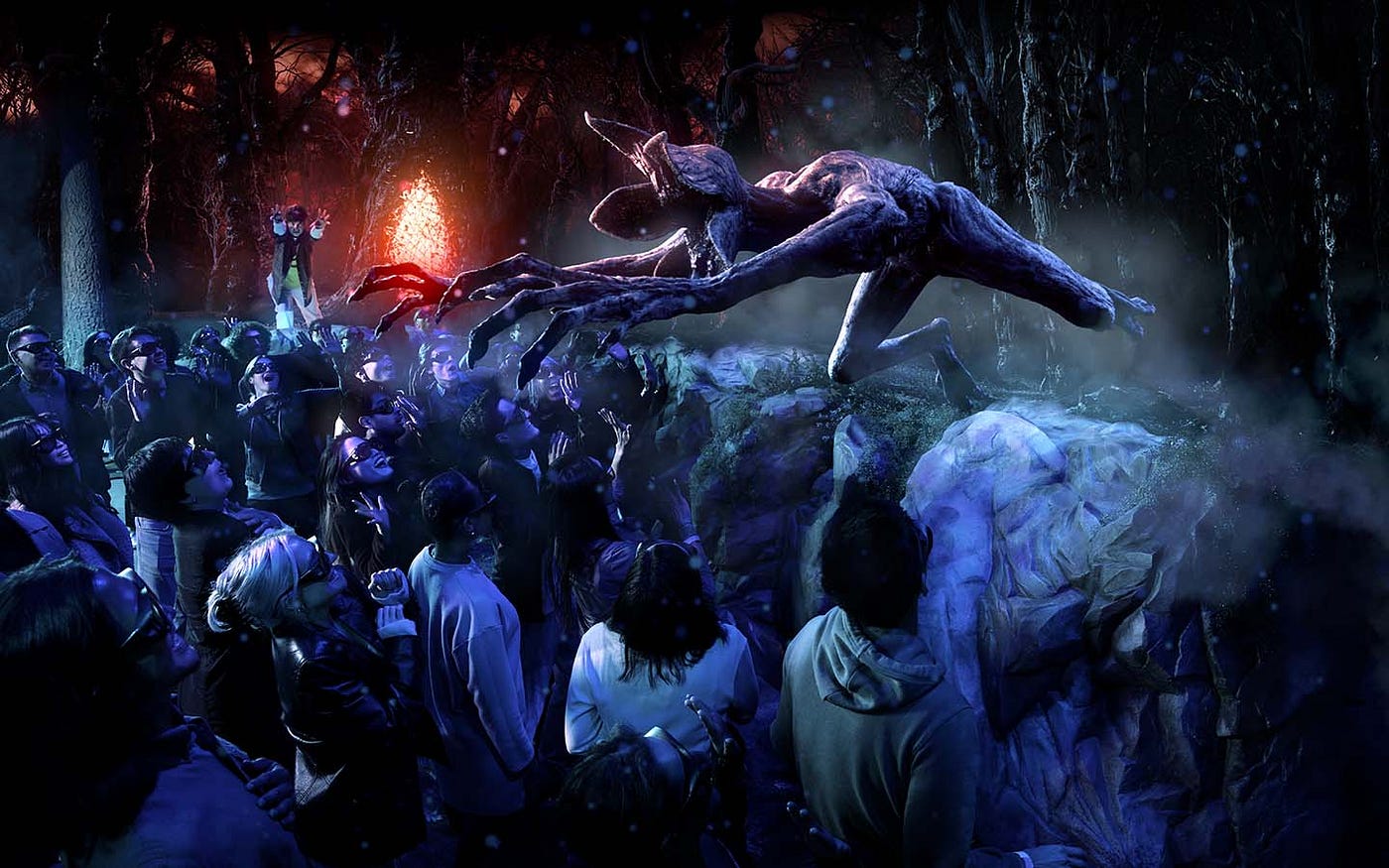
There may only be five reviews, but it’s a MIGHTY, MIGHTY batch with Leah Davis diving into the Stranger Things experience which is kicking off its run in NYC before popping up in San Francisco later this summer and Laura Hess giving a preview of her full review of A Forest For The Trees, which we featured on the podcast recently.
Plus the latest from City Lyric Opera and New York Neo-Futurists in NYC and the new Barbara Kruger exhibit in LA.
Let’s goooooo…
Want more from the Review Crew? Last week’s rundown is here, and the most recent Review Crew podcast covered what’s hot on the Meta Quest headset.
Are you a creator who looks upon these reviews with jealousy? Okay, the positive ones, at least? Then you might want to check out our How To Get Covered By NoPro guide.
Don’t miss a thing by signing up for the NoPro Newsletter, and you can support our efforts by joining our Patreon.
A Forest for the Trees — Glenn Kaino presented by The Atlantic & Superblue
$9 — $50; Los Angeles, CA; Through July 10
Last week I time traveled. In downtown Los Angeles I saw the past and the future. There was water and fire, color and darkness, music and spoken word. I was gifted new rituals. I experienced ancient wisdom.
And I met robot trees.
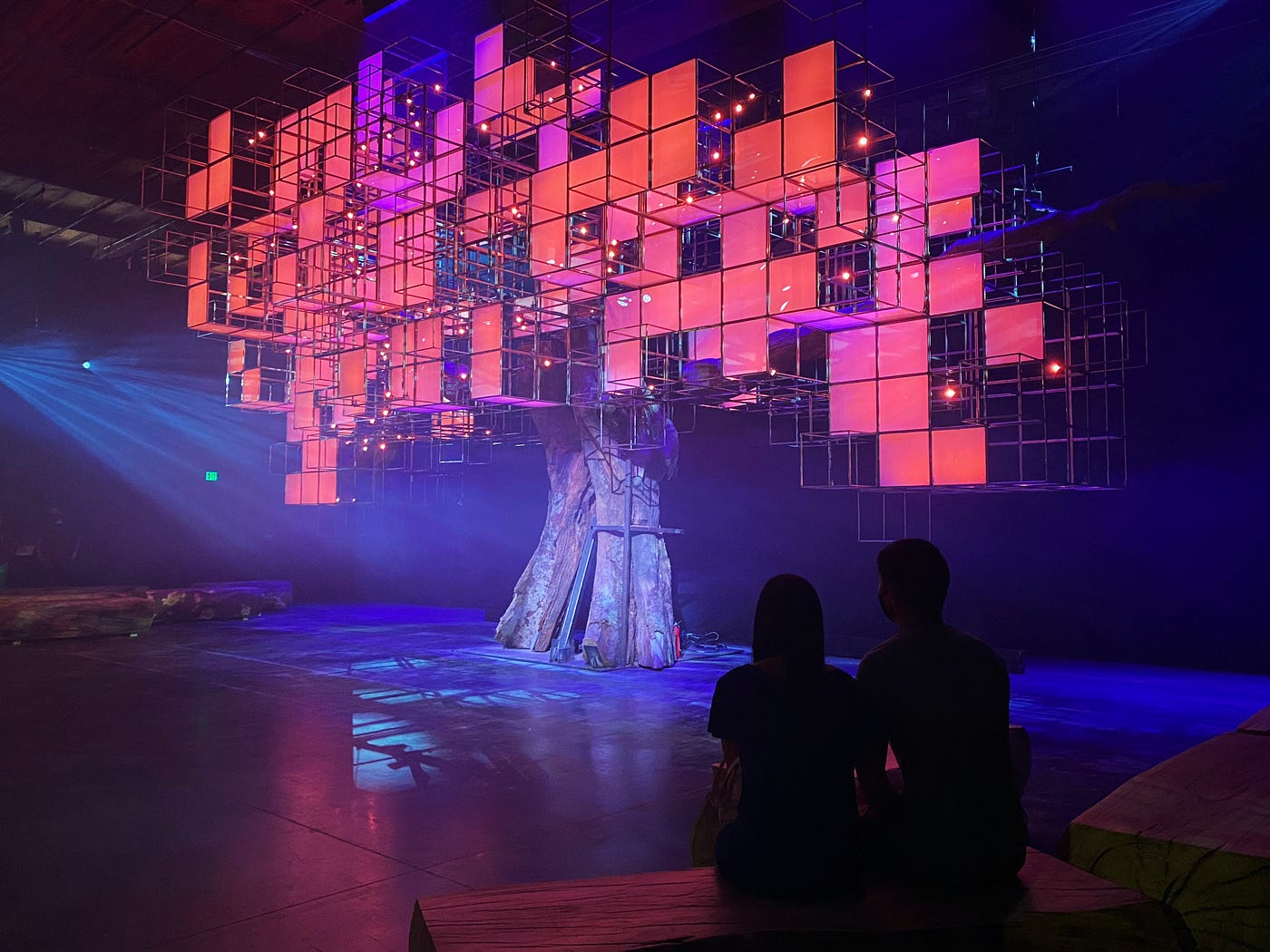
Inhabiting 28,000 square feet within a warehouse, A Forest for the Trees consists of interactive art, including multiple tree “performances.” Participants move through a progression of spaces and installations while retaining freedom of exploration and “agency of imagination,” as described by Glenn Kaino, the production’s creator. It’s a fusion of culture, science, and advocacy by way of embodied, immersive storytelling.
Presented by The Atlantic and Superblue, and sponsored by Mastercard, A Forest is the result of a “conspiracy of support.” This corporate network may seem like an odd family: an institutional publication, an experiential art initiative, and a payment platform. The connective tissue is the production’s clear and resonant intentionality around a fundamental question: Who owns our wilderness? Inspired by The Atlantic’s editorial series of the same name, Kaino created a constellation of partnerships which integrates Indigenous narratives, local history, the need for individual responsibility, and the opportunity for collective action.
Interconnectivity and magic are consistent themes throughout Kaino’s work and his creative process. He views the opening of A Forest as a beginning, a catalyst for participants to witness and contribute to the “forest of stories”; without this exchange the show is fractured and incomplete.
I view A Forest as another beginning. Kaino said “the opportunity of art is to show pathways for things that have not yet existed.” A Forest stands as a new example: holistic immersive. It’s participatory art fueled by inclusive and empowered collaboration, ethical and sustainable practices, and diverse institutional support, all with the singular goal of building community through empathetic action.
A Forest for the Trees presents a set past. It also offers a possible future, full of magic both real and imaginary.
— Laura Hess, Arts Editor, from her forthcoming full length review

Barbara Kruger: Thinking of You. I Mean Me. I Mean You. — LACMA, MoMA, The Art Institute of Chicago
Free — $25; Los Angeles, CA; Through July 17
Masked and tired, I sat on a bench watching the video. I have a hollowness from recent years; my chest cavity feels cratered and clawed out. The video’s editing was fast and strange: photos of adorable cats in toilet bowls spliced with declarative text and violent landscapes. It was a fantastical, relentless assault — mostly harrowing, sometimes funny, and so…familiar.
The familiarity was terrifying.
Barbara Kruger’s exhibition at the Los Angeles County Museum of Art is a massive showcase of her video installations, audio soundscapes, tabloid-style pop culture collages, and large-scale, austere text (in some cases wrapping entire surfaces in printed vinyl). With works from the 1980s to the present, the scope of the exhibition is impressive and the audacity of her art remains potent. Kruger’s work has always possessed a no-holds-barred, pressurized velocity; what’s different, and unnerving, is how familiar the brutalization feels.
The seminal piece Untitled (Your body is a battleground) has been expanded, both in construction and meaning. Originally created during a wave of anti-choice laws, Your body is a battleground was designed for the 1989 Women’s March on Washington in support of reproductive freedom. Now presented at LACMA as a video installation, the artwork is transformed into a sonic and cultural trebuchet.
That first video banks Kruger’s unyielding poetry against quotes by Kendrick Lamar and Voltaire (“Those who make you believe absurdities can make you commit atrocities”). With the rise of “alternative facts,” we are living in a decay of ripe absurdities and fermenting atrocities. Kruger acknowledges our “gift for cruelty” and “the war for me to become you.” Experiencing her body of work feels like putting on an old pair of shoes, molded to collapsed arches. The agonizing resonance of her work combined with a current ease of understanding is devastating. It shouldn’t feel this known.
— Laura Hess, Arts Editor
The Garden of Alice — City Lyric Opera
$35; New York, NY; Run Concluded
Get No Proscenium’s stories in your inbox
Join Medium for free to get updates from this writer.
SubscribeSubscribe
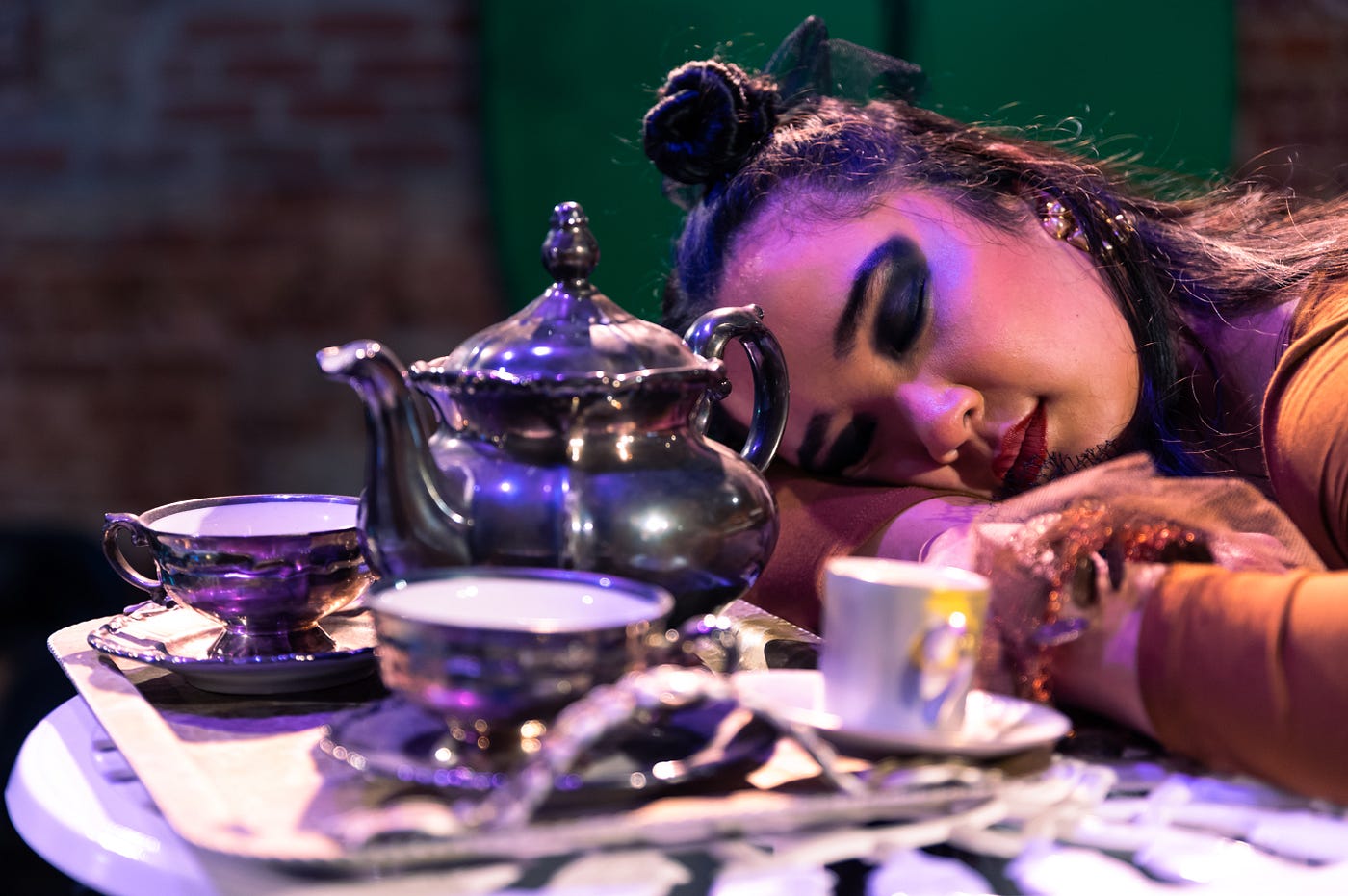
A young girl stares blankly at her phone, completely, entirely bored. As she scrolls through different social media feeds, behind her a rabbit seems to appear out of the digital framework of her phone, before appearing in real life. The white rabbit looks at Alice, and begins to sing.
Performing out of The Blue Gallery, The Garden of Alice, a two act chamber opera by composer Elizabeth Raum, is given an enchanting outing by this young female operated company, a rarity in the classical music field. The libretto is simple but effective with a postmodern score that utilizes extended techniques to the fullest with the sextet orchestra, that has little in the way of repetition or musical throughline. However this is fitting for the haphazard journey that our young heroine embarks upon, each interaction being a scene unto itself. All of the musical performances are truly delightful, with Laura Soto-Bayomi’s Alice having the great weight of the production on her baby-blue adorned soprano shoulders. Witnessing their powerful voices in such intimate spaces is a treat.
All of the design arts for this production are top class, from wonderfully crafted sets, costumes, lights and virtual augmentation to the stellar cast of musicians. Green screens hang about, enabling characters to appear virtually anywhere. Multiple costume changes are called for, with the cast playing multiple roles, including many Wonderland characters that are often ignored in immersive retellings. With the aid of technology we are able to see the baby turn into a pig, which itself plays out in the form of a tamagotchi. A giant caterpillar, with a contemporary vape pen, engages Alice with riddles. Pink Wii remotes are used for croquet mallets, which in turn push a pre-programmed animation of hedgehogs on screens surrounding us. This tech inclusion can be both impressive and amusing, although I find them taking away from the formidable live performances occasionally.
A last minute reminder of the doom-scrolling from the beginning of the opera rounds off the evening, with recent newsreels appearing around us, feeling perhaps a little on the nose, but the production on the whole is fantastic. We are invited to follow Alice as she walks through Wonderland, but these very clearly posted moments leave no room for interactivity or choice as we move through the experience. While perhaps light on the immersive aspect, this opera company is clearly trying to engage audiences in fresh and relevant ways, while maintaining the high caliber of excellence that one associates with the opera.
Brava.
— Edward Mylechreest, New York City Correspondent
Stranger Things: The Experience — Netflix and Fever
$44–72; Brooklyn, NY; Through July 31
Stranger Things: The Experience is a hella fun way to spend an afternoon!
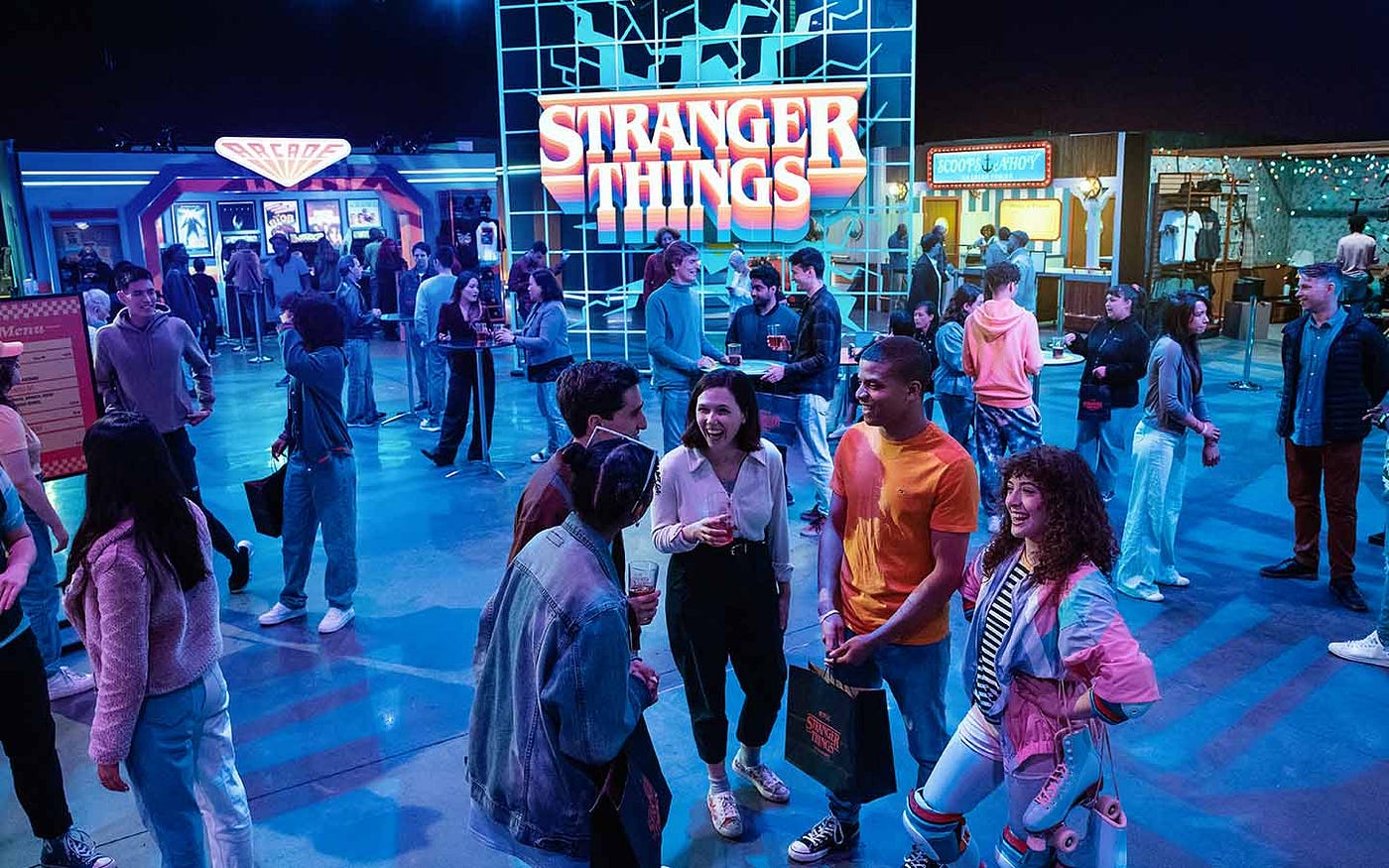
The Experience is split into two parts. First is a Hawkins Lab sleep study room that will help you tap into your own “special talents.” The lab focuses on a linear narrative with enough personalization to feel interesting and some stunningly efficient technology that makes the space feel super dynamic. The lab is followed by The Mix-Tape, a freeform 80s extravaganza space where you can chat with characters, grab some ice cream at Scoops Ahoy, buy Stranger Things merch, or camp out playing Joust in the arcade. The Mix-Tape is a self-directed space with tons to explore, expensive snacks, and a few cool mysteries to uncover.
Taken together (and I say this with the utmost love and respect because it was all done impeccably well), the effect is like going on a 3D roller coaster before getting spit out into the world’s best gift shop. It’s not a challenging experience, but that’s partly why I liked it so much. Stranger Things: The Experience signals an industry-wide willingness to keep investing in immersive across the board — yay! — but it’s also the experiential summer blockbuster we’ve been craving.
— Leah Davis, New England Correspondent — from a forthcoming full review
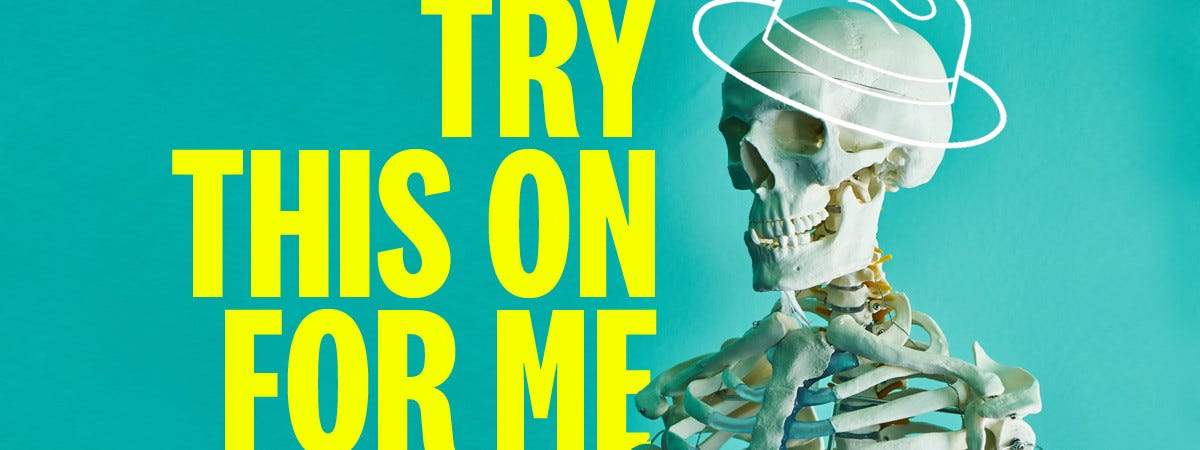
Try This On For Me — New York Neo-Futurists
$23–25; New York, NY; Run Concluded
What are you wearing?
Seriously — what are you wearing? Is it something that makes you feel your best? Or is it sweatpants? Maybe your answer is different today than it would have been two years ago, before a pandemic fundamentally changed the way many people work and socialize.
As life continues its slow return to normality, our clothing — the way we portray ourselves to other people — is something that must be considered again.
Try This On For Me, produced by the New York Neo-Futurists, invited participants to rethink the way we look at our personal style.
During the show’s roughly 75 minute runtime, Try This On For Me’s writers and performers Lee LeBreton, Anooj Bhandari, and Nicole Hill examine the ways clothing intersects with everything, from gender expression and colonialism to the legacy of slavery and the challenges of growing up as a first-generation American.
By tying clothing and personal style to identity — both personal identity and the identity that others create for us, based on our appearances — Try This On For Me seeks to elevate the importance of fashion in making us feel like, well, ourselves.
Some segments of the performance worked better than others. LeBreton’s monologue about the difficulty of shopping and finding clothing that felt validating post-transition was moving. Bhandari’s song about the trauma that ensued from his immigrant parents mistaking boxers for outerwear (“They Thought They Were Shorts”) got some giggles.
But by trying to cover too much ground, the overall impression of Try This On For Me was something that was scattershot and confused, feeling more like a collection of thematically-tied monologues by different performers than a unified story.
When the performance concluded, LeBreton played an ABBA song on piano while the audience “shopped” in the theater’s wardrobe, each of us allowed to take home something special for ourselves.
— Cheyenne Ligon, NYC Correspondent
Discover the latest immersive events, festivals, workshops, and more at our new site EVERYTHING IMMERSIVE, new home of NoPro’s show listings.
NoPro is a labor of love made possible by our generous Patreon backers. Join them today!
In addition to the No Proscenium website, our podcast, and our newsletters, you can find NoPro on Twitter, Facebook, YouTube, Instagram, in the Facebook community Everything Immersive, and on our Discord.


Discussion