



There’s a thematic undercurrent in a lot of immersive work right now, one that the form is uniquely positioned to manifest, a theme that can be captured best by the original traditional motto of the United States: e pluribus unum. Out of Many, One.
The theme emerges at a time of deepest fracture here in the U.S.. The kind of fracture that can feel terminal, if one thinks of history as being linear. Yet in the face of a society that has been structured around alienation — from each other, our institutions, our own agency — a countercurrent of culture is stirring. The human urge to gather, the need to be part of something bigger than the self, is exerting a tidal like pull on our bodies and souls even as out built environment and the mechanics of our economy seeks to wrench us further apart.
The culture of isolation and the instinct to thwart that and replace it with its polar opposite is what I found myself contemplating at a bone deep level during and after my time in The Still Point, the new feature-length work from Sophia Stoller’s Iris Company, who make their San Francisco Bay Area debut with the work.
It has been nine years since I last witnessed a piece by Iris Company — The Other Side — which marked Stoller’s foray into immersive dance theatre in Los Angeles. Whole eras have happened since then although, like the figures the audience encounters at the beginning of The Still Point, it often feels as if we are trapped in a looping limbo where progress is little more than an illusion.
Onboarding
The mechanics of the production begin at check-in, when the box office hands each patron a black business card with rounded corners. This acts as the ticket for the show. On one side is a QR code that leads to the program, a ubiquitous feature of indie performing arts in this age, and the other is one of four illustrations labeled either Water, Sand, Shadow, or Void. At the moment of check-in no explanation is given, only that the card is your ticket and you will need it.
The physical card, compact and black with fine details and a good weight to it, itself felt like a precision instrument built for purpose. It caught me a bit off guard, if for no other reason than that the form factor is very good and I don’t really know why I haven’t seen it deployed all the time. My companion and I also were each given different illustrations, which led me to expect us to be separated.
That process did happen in the lobby of SOMArts, the non-profit arts space situated under the tangle of freeways where SF’s SOMA district brushes up against where the Mission District and Potrero Hill meet. One by one the compact, athletic forms of dancers slipped into the gathered audience in the lobby of the space, until a veiled figure (Ava Shannon), their voice amplified over unnoticed speakers, setting up some of the thematic exposition for what’s to come.
It is only then that another of the dancers took to giving us the rules of the space, and letting us know that we would be following docent-like figures into the space beyond. More often than not I don’t approve of the “real world” rules being given after the action of a piece begins, but here the process was done with enough clarity and confidence that I felt like we were in good hands going forward.
(That’s the concern with the order of operation around disclosing the ground rules: being made sure that everyone, especially the production, knows how to take care of any emerging issues that might disrupt the production or pose a real risk to any or all present. It is possible to convey these elements inside the frame of a work, but extra care must be taken to avoiding blurring the lines.)
Water, Sand, Shadow, Void
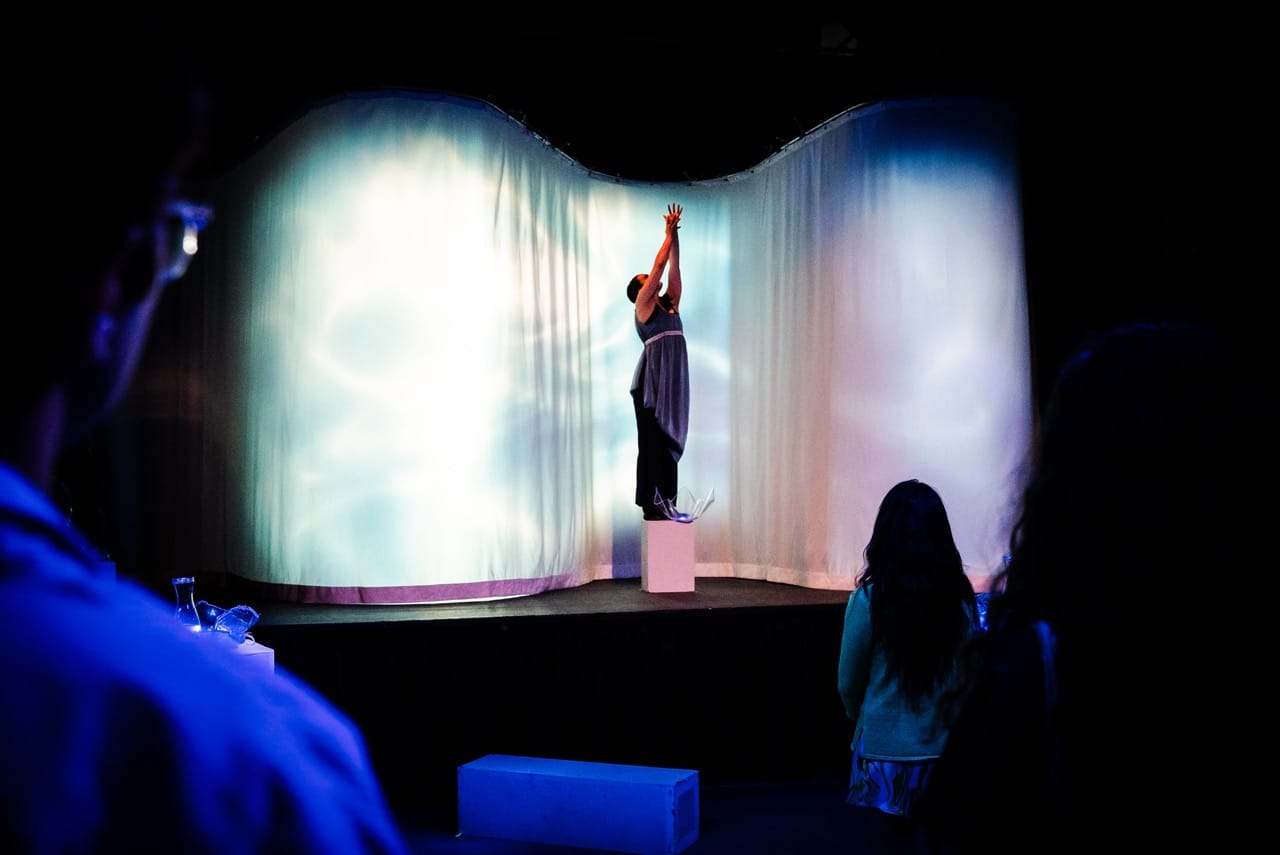
One at a time the four different groups, our ticket-cards determining where we started our journey, were led into the performance space. SOMArts theater and its galleries were divided into four distinct playing spaces by black curtains and plastic sheeting. The production design was minimalist, with each of the four vignettes anchored by a distinctive feature or three — the stage and gallery pedestals for Water, a stretchy fabric with a visual texture projected onto it for Sand, a series of hanging scrims for Shadow, and a set of stairs that led up to a wall projection in Void — and a soundscape that used the audio bleed between the spaces to its advantage.
I began my journey through the four vignettes in Water, a solo piece featuring the talented Haylee Nichele, who long performed in Sleep No More whose immersive credits include the role of Alice in Then She Fell, the VR game The Under Presents, work with L.A.’s The Speakeasy Society, and the recent You Must Be Here For The Reading. In other words: Nichele is no slouch, yet Water — framed on the stage and around the gallery plinths — did not take advantage of her site-responsive skills or ask much of us as an audience. At this point in the swing of things, the fear that this would be not more than a series of performance vignettes in a non-traditional space, crept in.
After all it’s an act of faith, and a huge gamble, to take a six hour drive to catch a 90 minute show — especially a 90 minute show from a company whose work you have not seen in nine years. What if Stoller wasn’t interested in delving into the relationship between audience and artist in the way that Iris Company’s The Other Side was way back in 2017?
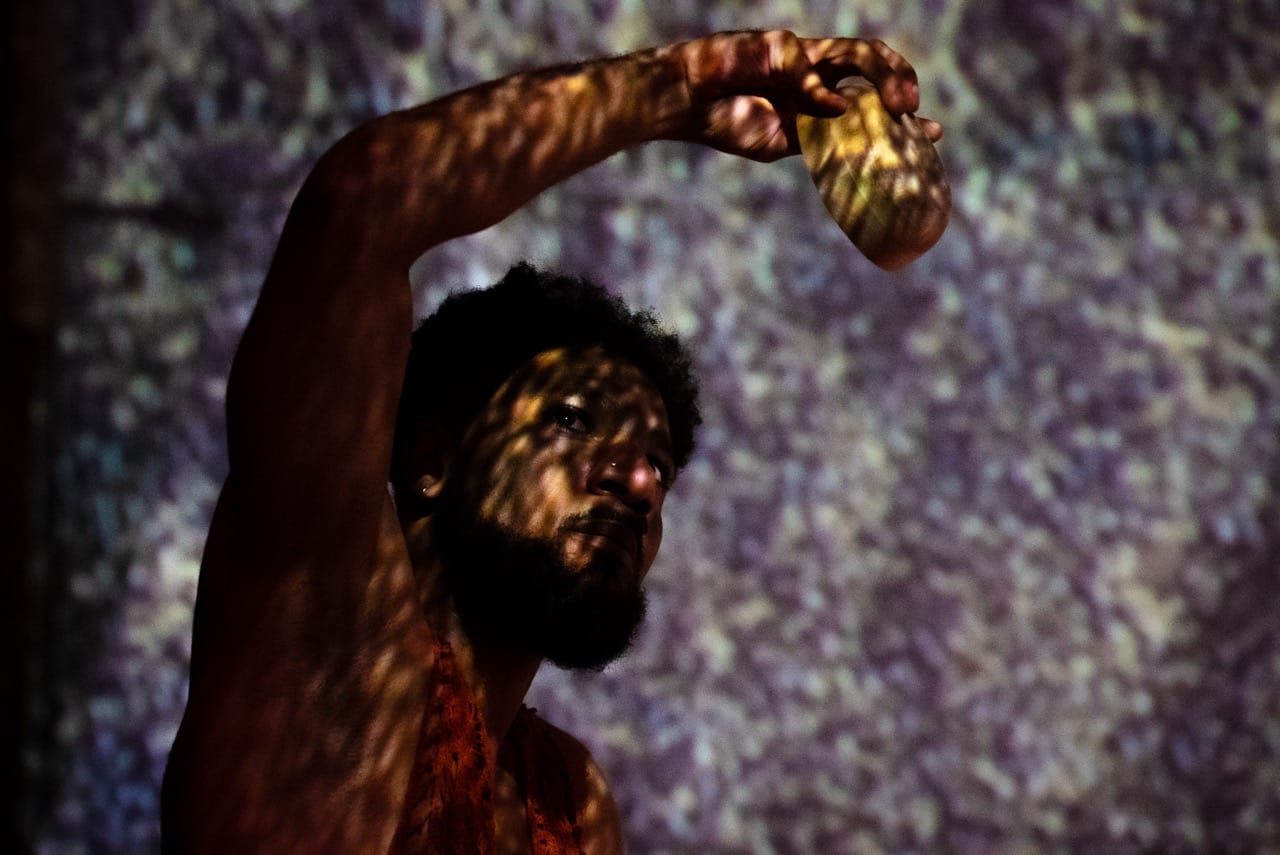
The next vignette I caught — and mind you depending on what card you were assigned you had a different sequence — was Sand, and it was a visual spectacle that melded space, projection, sound, and performance from dancers Kevyn Butler and Will Ervin Jr. in breathtaking ways. (Shout out to Aron Altmark of Visual Endeavors for the lighting & video design, which shines here.) Here the audience was a bit more of an element as the performers navigated around us as they embodied the element. Yet we were still far from what we might consider interactive.
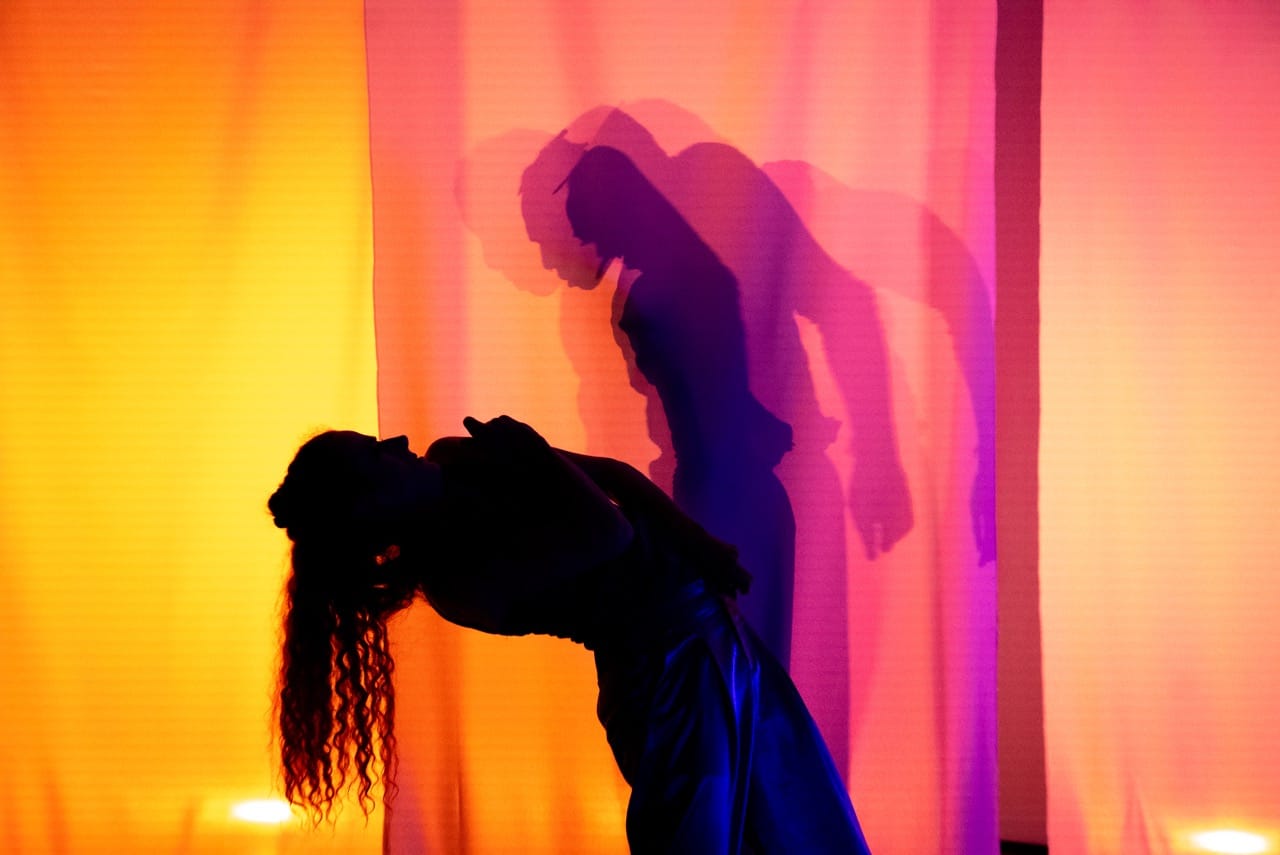
If anything Shadow, at least as my audience group arrayed itself, featured almost no push and pull between performers and audience. What it did was introduce a vital thematic element that could best be summed as “conflict in reflection” between the duo (performed here by Jae Neal and Livanna Maislen), which reads as both a tempestuous fight between lovers and a deeply divided self.
In Void the line between audience and performer is blurred as we are enlisted in the conflict between the duo of this piece (Majella Bess and Marcel Mejia) who are trying and failing to collaborate on building some kind of structure with fabric wrapped foam shapes. There is also the stairs to contend with, which the pair are tempted to traverse up at times, and at one point even enlist members of the audience to help roll a circular shape up the steps.
As luck would have it I was one of the audience members chosen for the task, and by equally by luck the timing of this mapped my own personal experience of agency in the overall sweep of the production to the linear flow of time. Because at the culmination of the Void sequence the first breaking of barriers between the vignettes occurred.
The Walls Come Down
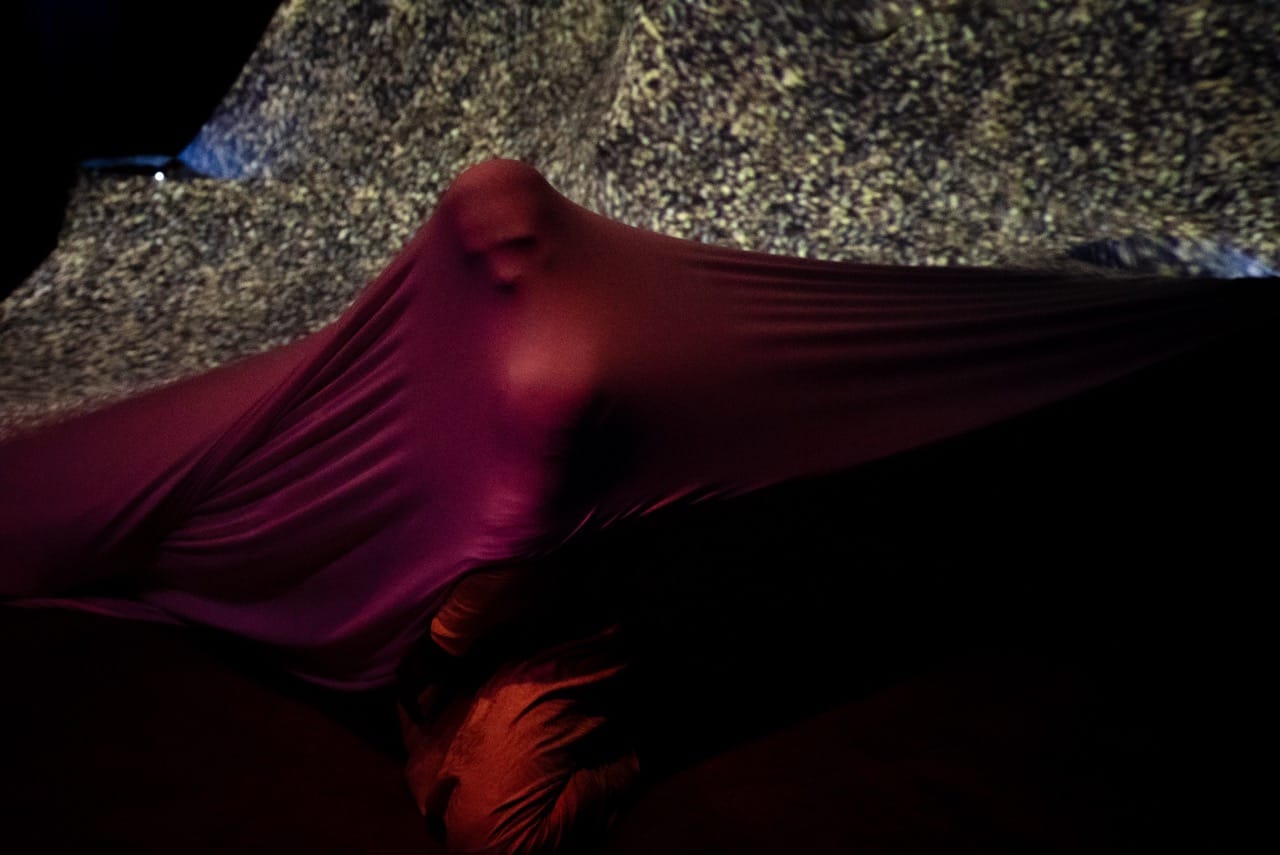
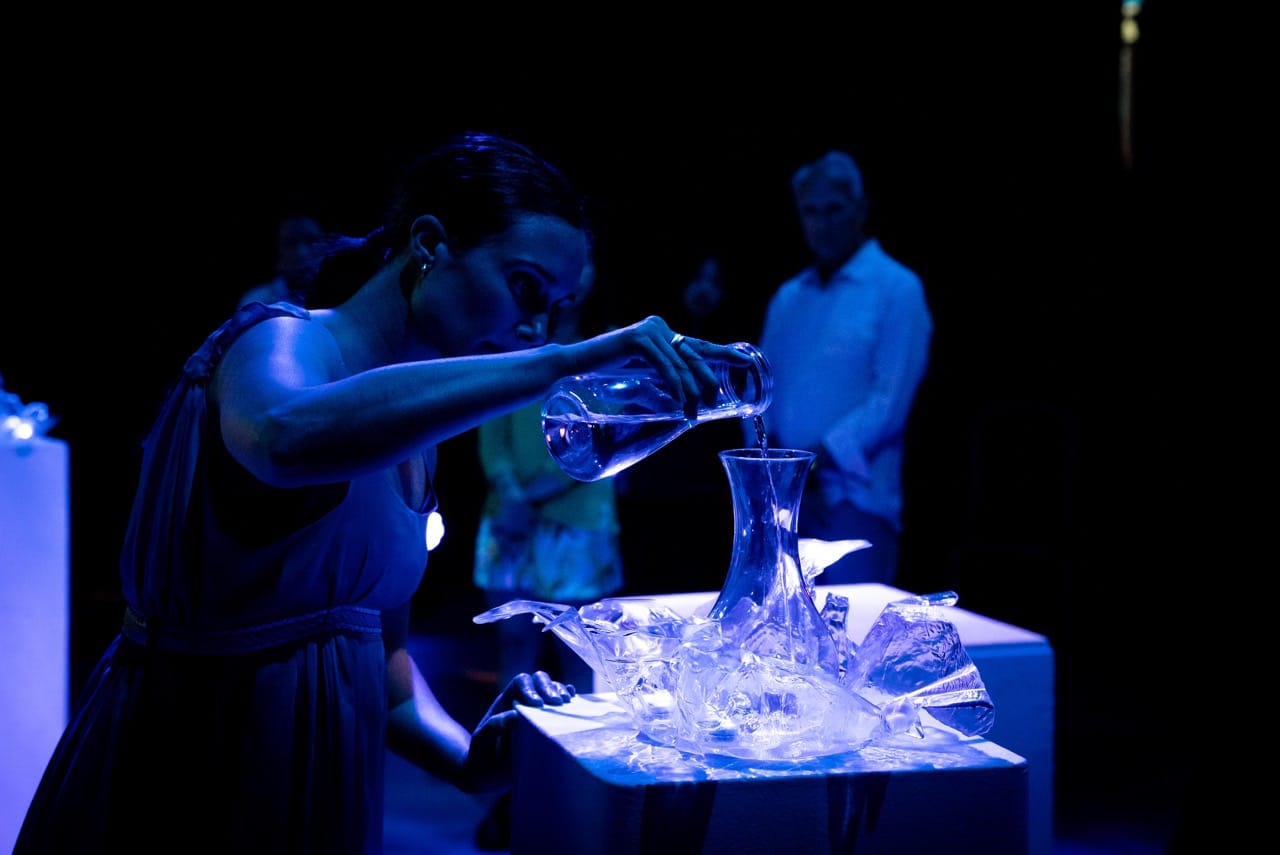
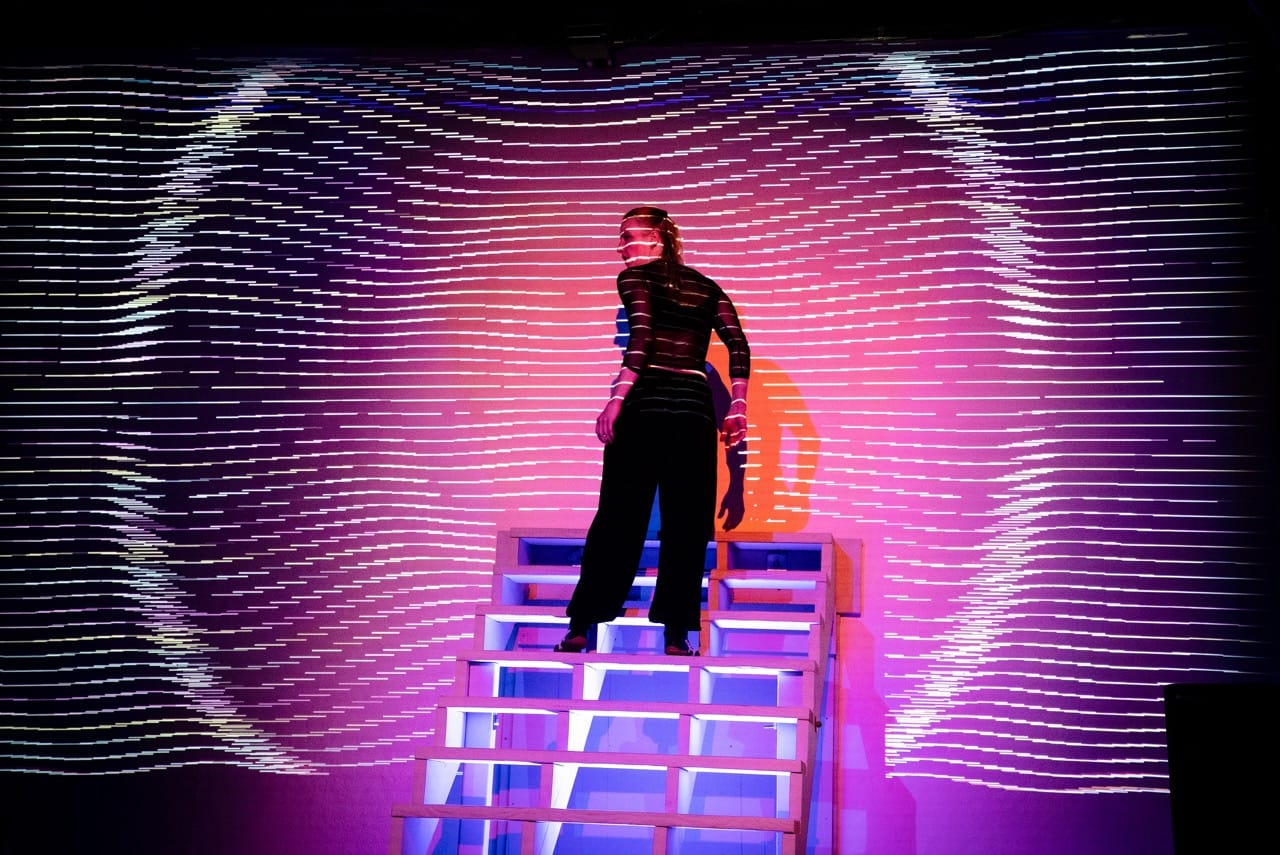
Production images from Iris Company's The Still Point (Photo: Nic Murphy)
On one side of the central curtain Void and Shadow were transformed into one space. Both performers and audience now mingling in together. The traits of the performer’s “characters” coming into contact with each other and influencing the way they moved through the space and with each other. (I assume something similar was playing out amongst Water and Sand.)
The dancer-docents, and other as yet unseen performers, began to join as well. Soon the central curtain was drawn apart and the full space revealed. The audience confronted with its own archetypical reflection.
From here The Still Point took off, with the audience becoming the medium through which the dancers moved — a material in the choreography even as the isolation and individuality of the dancers themselves gave way to being part of a greater whole. This recontextualized the fractured way in which each of the vignettes existed at the start of the piece, and the limited way in which the audience existed in relation to those pieces. The isolation of performers and audience alike became the material concern of the work, illustrating the very themes that seem to plague our society and pointing towards the solution — in the sense that a solution quite literally dissolves a matter.
On a visceral level the gift of witnessing dancers at the height of their powers up close — their synchronized movements whipsawing the focal point of the choreography around the space and across their assembled mass with laser like precision — is intoxicating. This up close work is no small part of the appeal of Punchdrunk’s masterworks, and so it should come as no surprise that members of this incarnation of Iris Company are veterans of both that company’s productions and those built in that style.
The Still Point builds to be something electric, drawing its power from the eternal moment we inhabit and transmuting it into something visible.
Promising perhaps that what we can see, we can change.
The Still Point is presented at San Francisco's SOMArts, July 16 - 25th. Tickets are $66.
Discover the latest immersive events, festivals, workshops, and more at our new site EVERYTHING IMMERSIVE, home of NoPro’s show listings.
NoPro is a labor of love made possible by our backers. Join them today and get access to our Newsletter and Discord!
In addition to the No Proscenium website and our podcast, and you can find NoPro on Bluesky, Facebook, LinkedIn, YouTube, Instagram, and in the Facebook community also named Everything Immersive.


Discussion