


The personal storytelling show relies too heavily on forced audience participation
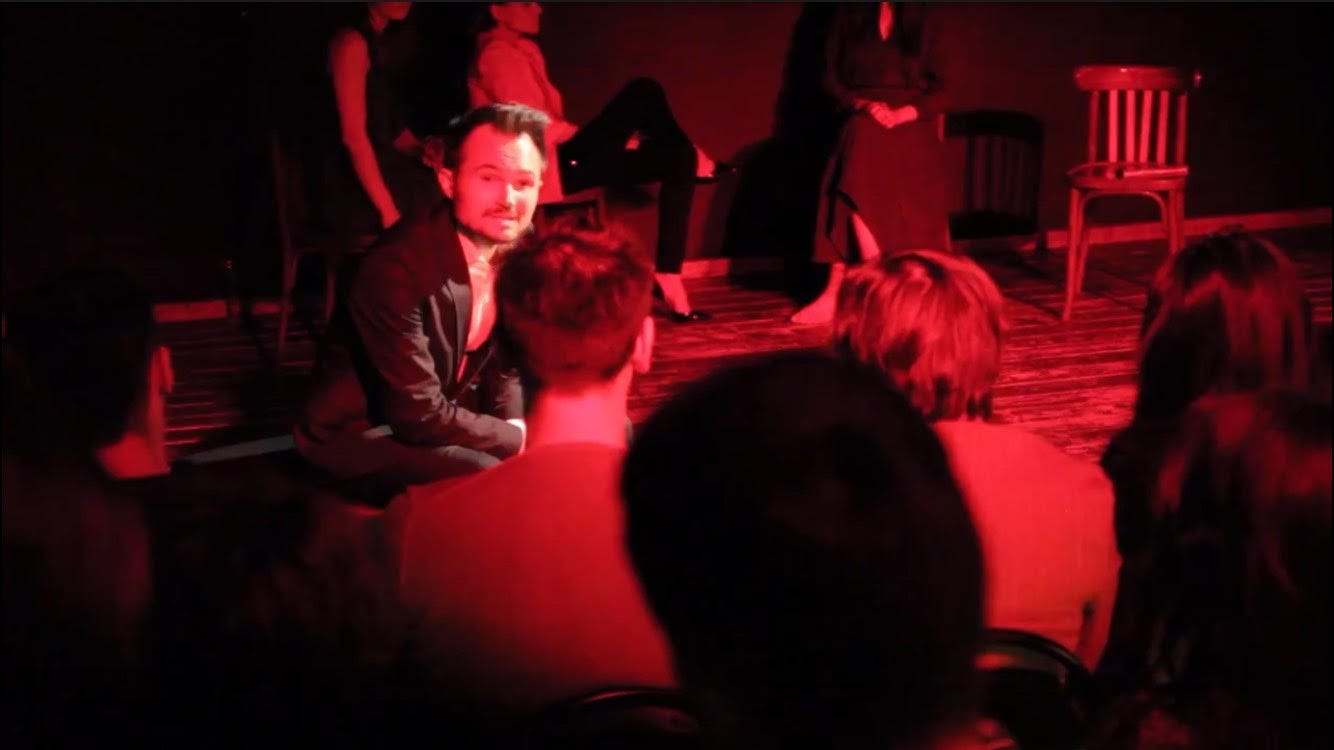
I’ve been told that there’s a dress code in order to board the train. It feels strange but appropriate; I’m going to attend Passengers, a experience promising a “Trans-Siberian” train journey which “invites you to engage in re-experiencing your past and re-thinking your present.” Before entering the experience taking place in the lavish Player’s Club in Gramercy, I am excited to see how they might incorporate this unique setting into such personal reflections. (It turns out, it was an answer I would never really get.)
Though the piece is centered around, and heavily marketed as, an experience taking place on a “train,” there was no indication from the environment that that was actually the case. The only “train-like” touches were some stock sound recordings, coming from a visible AV table, situated in the back row of the audience. Truthfully, there was hardly anything at all to distinguish the environment from a typical proscenium piece. As a whole, Passengers felt less like theatre and more like first-person storytelling, with the script delivered almost exclusively via longform monologues, recounting stories from the characters’ pasts that meditated on everything from cancer to grief. As an audience, we remained seated for the entirety of the piece, in a well-lit room that left me feeling exposed and distracted. Even where there were theatrical moments, in which the characters recounted intense traumatic experiences from their lives, it felt hardly immersive. We had no agency, and were given little freedom to affect or even explore the experience.
The truth is, this wasn’t due to a limitation on space as Passengers had a gorgeous setting to work with. The room in which the show took place was exquisite, with mile-high ceilings and dark wooden walls. Extravagant portraits lined the space and there was even a stage with crimson curtains, which sat unused behind the three actors as they had parked themselves in chairs on the floor to deliver the piece. There was even a full lighting rig and enough unused space to tuck away the sound booth — both amenities that felt noticeably neglected. I questioned why they hadn’t arranged the lines of folding chairs into some kind of pattern that might call to mind train seating, which would have also given the actors more freedom to roam. Instead, the performers remained almost exclusively in front of the audience with scarce blocking to move them elsewhere only once or twice throughout the piece. The fact of the matter is, a couple promenades around the blockade of audience seating does not an immersive production make.
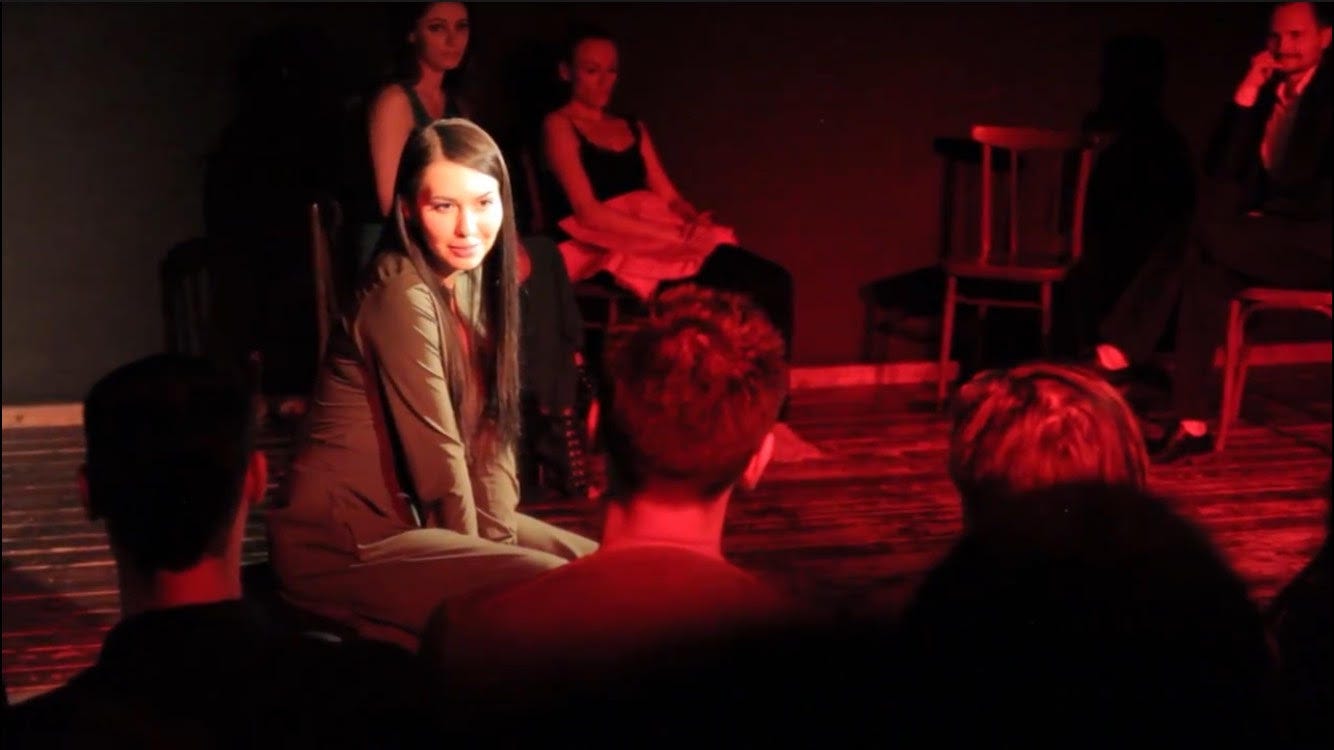
Unfortunately, the only attempt made by Passengers to create a more active experience was the use of the “question and answer” format. Used as the primary (and nearly only) “interactive” device in the experience, the format became predictable and boring: a character would start a monologue, stop to ask a question related to what they just said, and then share a moral stemming from what they had just said. This happened every few lines. This format ended up feeling underdeveloped, not offering much variety or depth in how the piece was presented. This pattern also created mechanical flaws in the piece’s delivery, as it relied heavily on audience’s attention and verbal responses to create an interactive experience. In the midst of the conversation it was not always clear which audience member was being addressed when, leading to awkward pauses or confusion. The questions themselves, though sometimes inspiring conversation, often led to dead ends, not really offering any good ways for the actors to recover in the event that they received an answer that didn’t match their expectations. Often times, the reason for the questions being asked at all was not clear, besides just being used as a device to incorporate the audience.
For example, an actor might tell a story about being lost in the snow. They then would ask a spectator if they too had ever been lost. When the audience member was done responding, the actor would return to their monologue, picking up right where they left off and often not commenting much on the reply at all. The spectator’s reply took on no value to the story except perhaps as a distraction mid-sentence. Frequently, when a question was asked that an audience member couldn’t answer, or had what was seemingly deemed an “uninteresting” answer, the actor would move on to a different person and ask the same question. This left behind a (possibly unintentional) feeling of failure: either the audience member wasn’t successful in answering, or the actor wasn’t successful in asking, or perhaps both. What could have been a special moment for an audience member then turned into a moment of being deemed not “good” enough. This problem could be easily solved by reformatting the question or finding ways to build off of any type of answer, or simply approaching the conversation from a spontaneous and authentic place. For example, immersive darling Broken Bone Bathtub uses a similar format, but chooses to approach the audience’s responses in conversation as the priority, rather than focusing on progressing the scripted narrative. By listening closely to the audience, the experience becomes more about catharsis and reflection. Instead, Passengers made the entire “questioning” routine feel like just that — a canned routine.
Perhaps the largest problem came from a combination of the both the show’s environment and the questioning of the audience. Sitting in that well-lit room, packed with strangers and a few characters (with whom I hadn’t bonded), I felt thoroughly uninterested in answering their questions; even worse, I sometimes felt wholly resistant to answering them. With some questions obviously meant for soul-bearing answers on the part of the audience, I had also not been set up to trust those around me. With neither an expectation of privacy nor a sense of intimacy established and also lacking a proposed reward for sharing, I frankly did not see the appeal of connecting with the characters, let alone opening myself up to sharing some intensely personal information.
Get Leah Ableson’s stories in your inbox
Join Medium for free to get updates from this writer.
SubscribeSubscribe
Beyond this, there was no consent to when or how an audience member could engage with these questions. Actors chose who they wished to question by simply scanning the audience and picking whoever they felt like addressing out of the crowd. Typically, I am the first to want to engage with an experience, as someone who keeps eye contact with performers, and waits for that outstretched hand or wink of the eye from a character as a cue to engage. But in this scenario, I struggled and felt more like I was being forced to participate in an icebreaker exercise among strangers. For the first time since high school, I found myself avoiding eye contact like an unprepared student in class, quietly praying that I didn’t get picked.
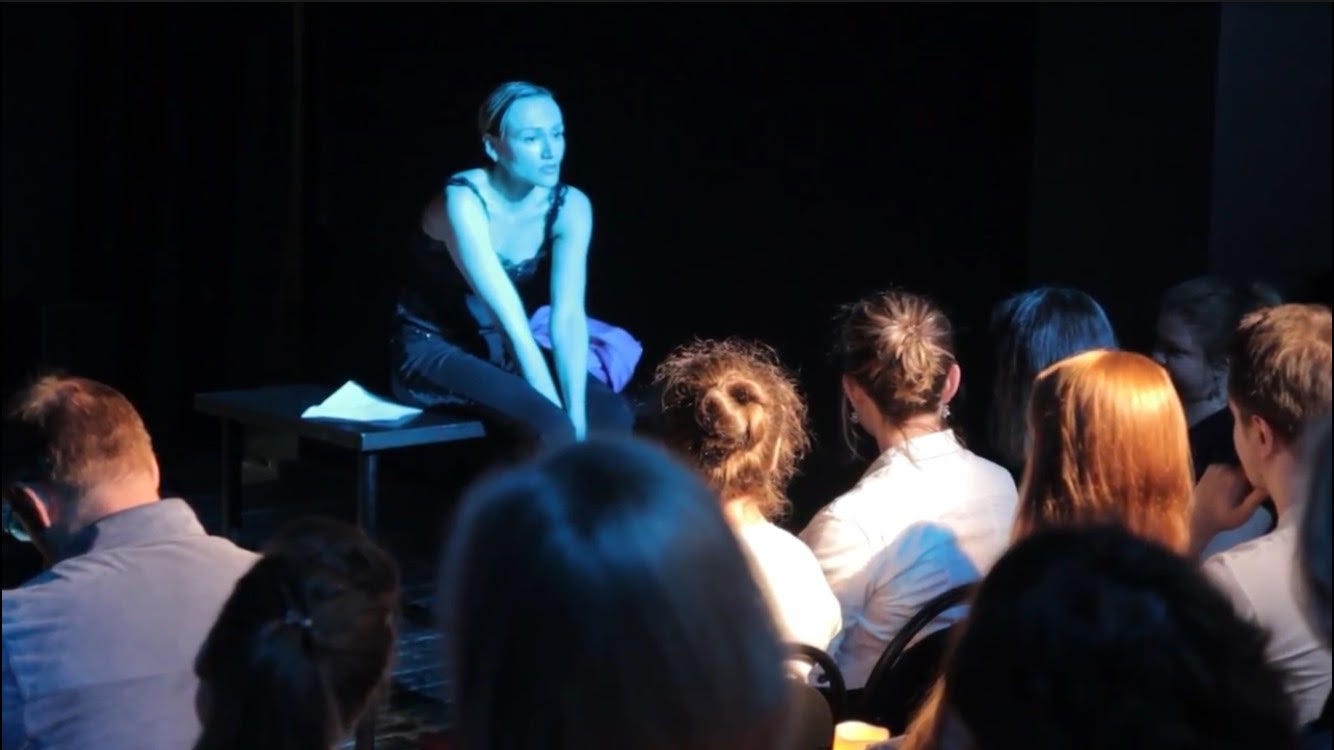
That said, I did see the actors stop a few times and really care for audience members; this showed a real promise in what Passengers was trying to do. In particular, one character was speaking about her grandmother and asked a spectator if she remembered her grandparents. The response was that the audience member had never met her grandparents, and the actor, thankfully, took a moment to place a hand on her arm and smile, and share a moment of silence with her. In these moments of active listening, the audience palpably became more open and attentive, including myself, because trust was slowly being established. That actor became the first and only one that I, finally, felt willing to speak to. If Passengers focused on this phenomenon and really committed to this practice of active listening, I think the experience would be largely improved. Perhaps one of the reasons why I found the questioning tactics most disappointing was because they pulled focus away from the emotional storytelling, and sabotaged the narrative by disengaging the audience from it.
However, the difficulties faced in establishing trust with the audience did not mean that Passengers lacked poignant stories. The writing of the monologues was perfectly fine, even great, at points. The storylines approached moving and relatable topics from picking apart toxic family dynamics to analyzing “fear” versus “confidence.” I applaud the Passengers team for striving to tell emotional and important stories, and looking to elicit vulnerability in the audience.
But unfortunately, Passengers suffered from what seemed to me like a shortage of care for their audience. While the format of questioning audience members ultimately did come from a place of wanting to create a thought-provoking experience, it didn’t build a compelling enough case or strong enough trust among the group to support this goal. It relied too heavily on the audience to carry the burden of creating a satisfying result, rather than offering a space to explore and open up.
In the end, perhaps Passengers would benefit from leaning more in either direction: either much more “immersive,” or not immersive at all.
The Passengers has concluded.
NoPro is a labor of love made possible by our generous Patreon backers. Join them today!
In addition to the No Proscenium web site, our podcast, and our newsletters, you can find NoPro on Twitter, Facebook, YouTube, Instagram, in the Facebook community Everything Immersive, and on our Slack forum.
Office facilities provided by Thymele Arts, in Los Angeles, CA.


Discussion