



The February afternoon daylight is dying quickly as I observe the Leake Street alleyway slowly filling with a crowd of people — people who aren’t joining the security line to enter the Vaults Festival. I watch as more and more arrive to gather around the sign for Bring Them Home, a new production by Treehouse. There’s definitely more visitors than I’m accustomed to seeing in Unit 9 and I’m looking forward to seeing how they plan to handle the numbers.
Over the two days previous, I had received several emails from the producers. The first message included basic gameplay details and encouragement to dress up for our roles as 70’s-era space agency employees who are tasked to guide home a stranded astronaut. It also included the option to pre-volunteer for particular special roles — as a member of the press or as the astronaut — ahead of showtime, each role having its own separate set of rules. It’s clear from this first email that Treehouse is pushing the game play aspect of the performance more than most.
After being confirmed as a “member of the press” I was subsequently sent another message which included press-specific documents and a welcome video to better explain the written rules. This was useful as the rules seemed fairly complicated; I’m not much of a tabletop gameplayer, so without explicit examples and graphics I felt a bit in over my head. The video was informal and kitschy with archived space exploration footage, but its objective to further pre-inform attendees on how to engage with the performance cemented the concept that this would be a tabletop gaming experience at its core, with elements of theatricality garnishing the main focus.
Now, waiting in the Leake Street tunnel, we’re eventually approached by an excited man in a suit who invites us to follow him to the base of operations. We follow him as he leads us to Unit 9 while delivering a cursory briefing; unfortunately many of us can’t hear him under the circumstances. The environment around us is loud and he’s focused on safely getting us inside and ready to play.
Once inside the largest space in Unit 9, we take in the sight of several trestle tables decorated in American, Russian, and European-themed paraphernalia and a ten-foot-tall rocket ship that looms over the proceedings. I anticipate some elaborate spectacle, perhaps involving the shuttle disaster that caused our astronaut to need rescuing. There is very little else in the way of decor; while the production does not boast an immersive set it becomes clear that an extensively curated environment is not necessary for the production to have its intended effect.
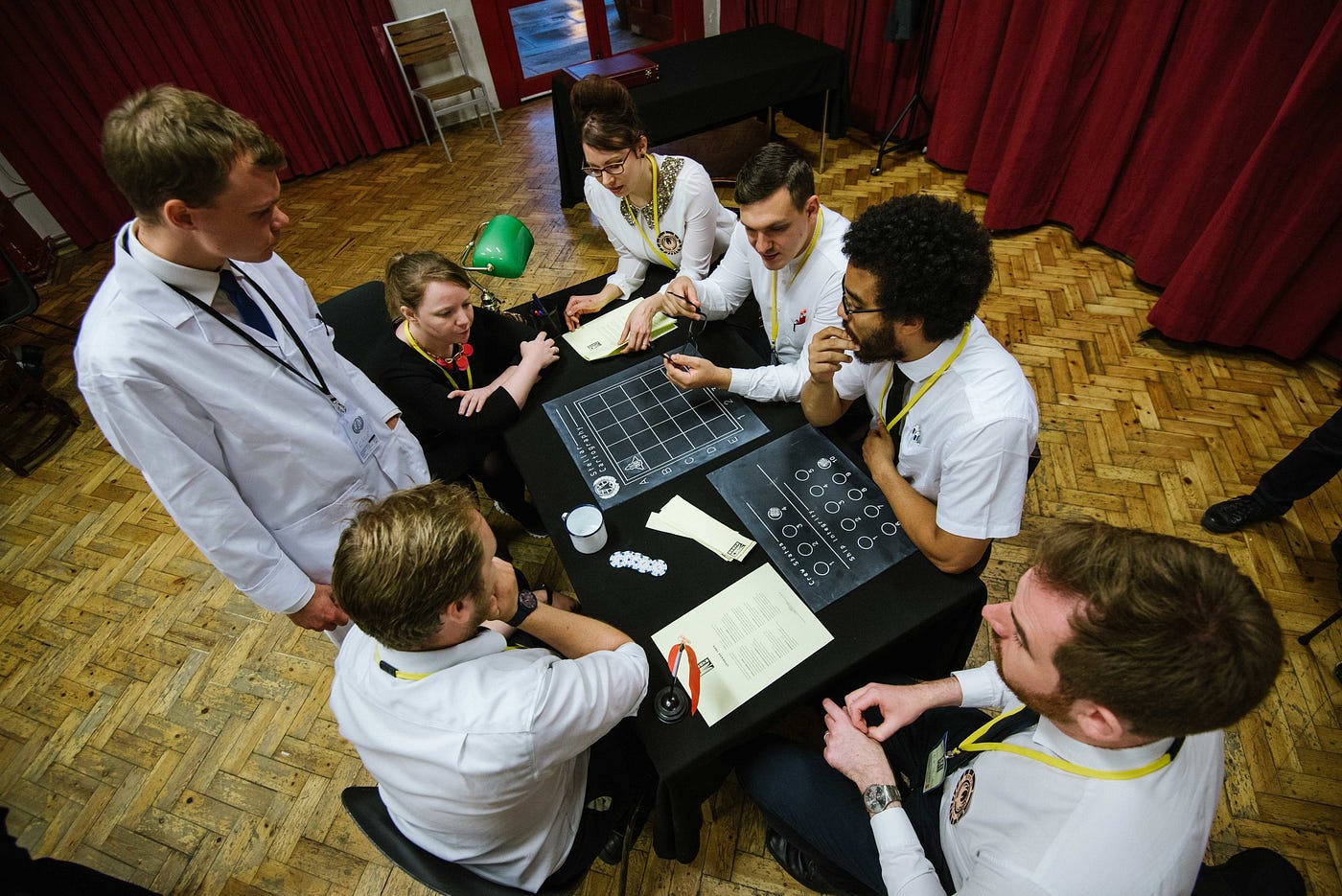
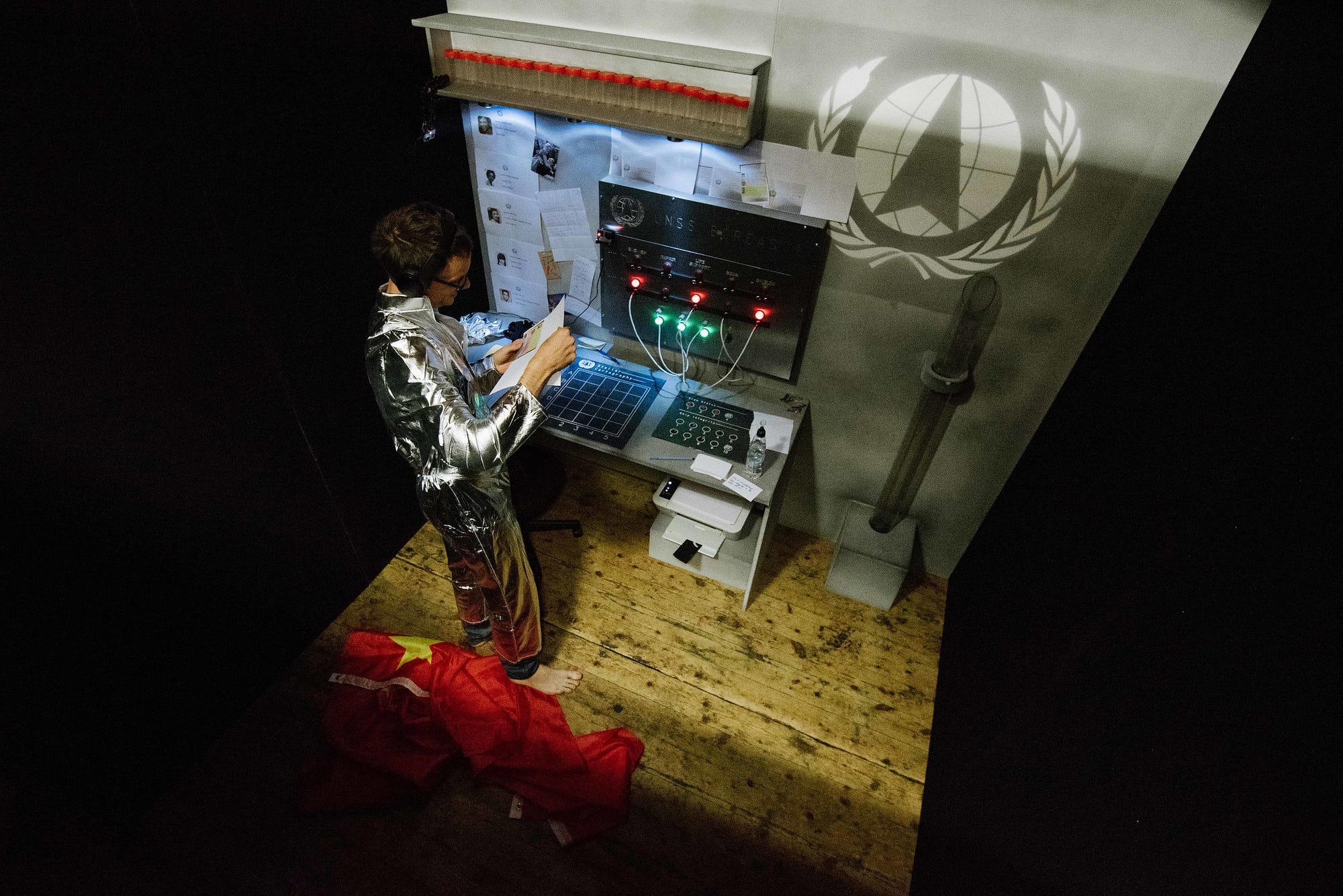
The audience is divided into three rival space agencies all with the primary directive of getting the astronaut (a lone audience volunteer isolated in another room) back to Earth. Through a series of turn-based strategic actions, it is up to the audience to determine if they will trust the other factions and agree to use each other’s strengths, or if they will become isolated competitors and attempt to rescue the astronaut on their own abilities. Facilitators for each team stand by to encourage and guide the teams through gameplay, reminding the audience of the rules and offering advice when a team seems particularly confused or inert. After the first two or three rounds (out of ten total), people begin to catch on how to play and interact with the other teams: while their prime objective is to bring the astronaut back to Earth, the seemingly real way to win the game is to earn “prestige points,” which are awarded by the press after each round, depending on how admirably the press feels each agency has performed.
As a member of the press, I also have a secret list of objectives, which I’m encouraged to complete by teaming up with my partner. She is so enthusiastic and engaged in her role that I suspect she is an actress who has been planted by the producers. But as I later learn, she is just a seasoned live action role-player who enjoys playing her roles — perhaps a bit too enthusiastically at times, as I feel uncomfortable working with a member of the audience who insists on pushing interactive boundaries in an environment where not all attendees are as equally thrilled about first-person improvisation. Personally, I would prefer to leave challenging an audience’s limits to (hopefully) trained actors who know best how to guide the emotional evolution of their own production.
Get Shelley Snyder’s stories in your inbox
Join Medium for free to get updates from this writer.
SubscribeSubscribe
That said, our objectives are meant to help motivate our actions during the gameplay but as the members of the press, we aren’t really driven to achieve any specific goals. There is no way for us to “win” the game ourselves. We attempt to encourage teams to engage more meaningfully with the press in order to solicit and garner more prestige points, but the teams remain focused on cooperating with each other or furthering their own goals to bring the astronaut home. Prestige doesn’t seem to matter to them. We as the press decide instead to spend our time asking incendiary questions intended to cause dissent and rivalry between teams. Some attendees emerge as particularly chatty and fall happily into the roles of agency spokespeople: by the end of the game these players are actively seeking us out to issue statements and request coverage on particular movements, though we find that occasionally agencies ask us to disseminate stories that later emerge as cover-ups for more nefarious activities. These discoveries prove to be the most interesting for us as the press, to find out that we have been gamed within the game by casual audience members rather than the facilitators.
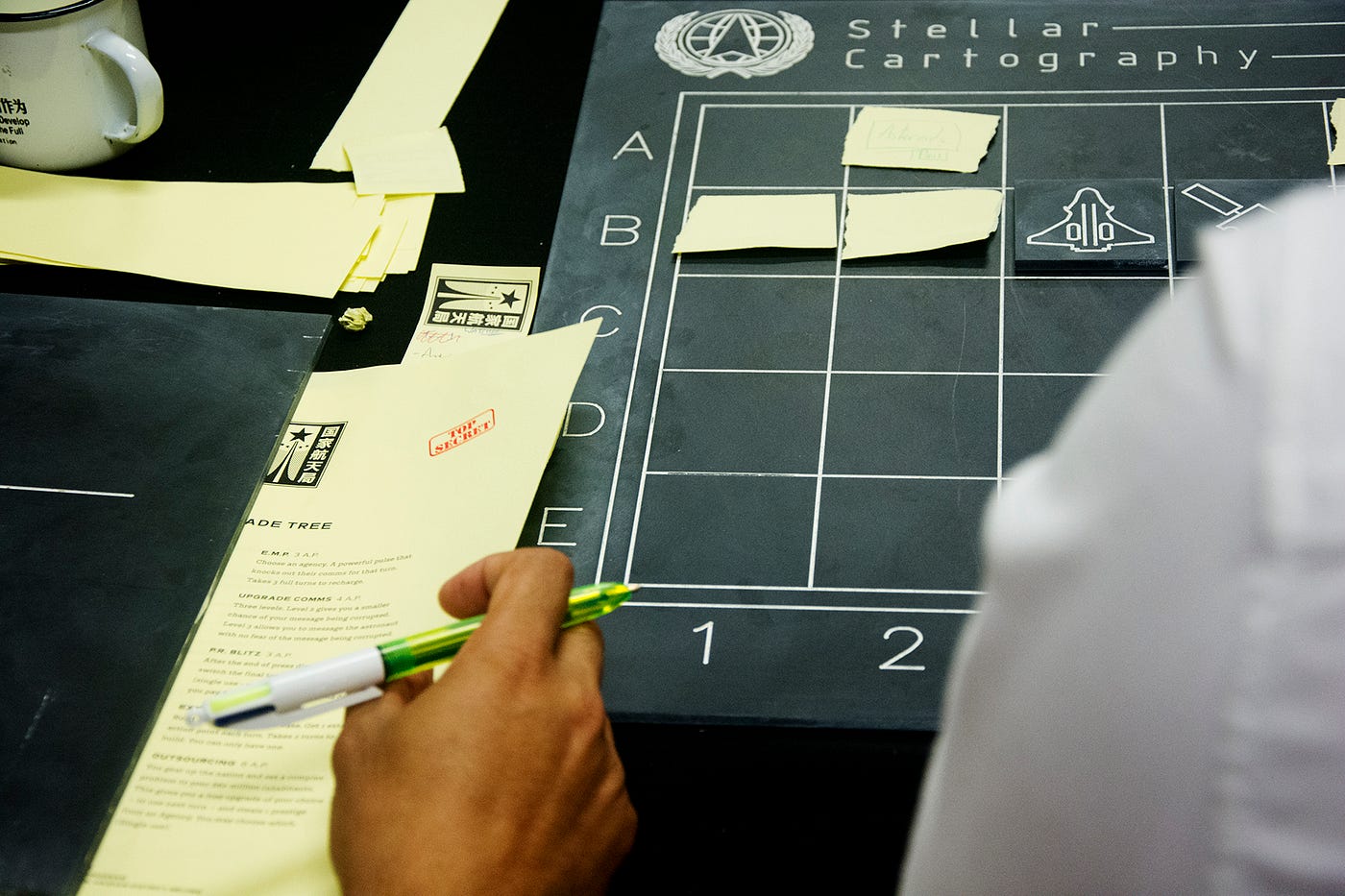
At the end of each round, the press is asked to deliver updates from the moderators regarding the status of the astronaut and then comment upon what each team accomplished during the preceding round before awarding prestige points. My press partner swiftly becomes biased against a particular team and discourages awarding points to them, and I notice that the team in question becomes visibly less engaged with the experience as they come to accept that they’ve fallen too far behind to win. Our moderators observe this as well and swiftly balance the prestige points to ensure the group remains motivated, but the damage has been done and the team incrementally becomes less invested with the game as it progresses. In the end, the astronaut is successfully rescued and the winning team is announced, but without an actual prize. It feels more satisfying to note that the prestige points did not really matter.
Are the players affected by the stereotypes of the region they’re assigned to? Does the Russian team intentionally obscure their positions and resources because of their superimposed profile? Does the American team demand more attention and responsibility, given their global caricature? Does the European team insist on interagency teamwork and open communication in the real-world age of Brexit? These are deeply subjective facets to consider within the experience of Bring Them Home, making it impossible to predict how each iteration of the game will go. The game itself is structured to encourage repeat visits and consistently challenge returning audience members. The assigning of real-world agency affiliations further muddies the waters of predictability.
Interactive, it certainly is. Immersive, it’s unfortunately not.
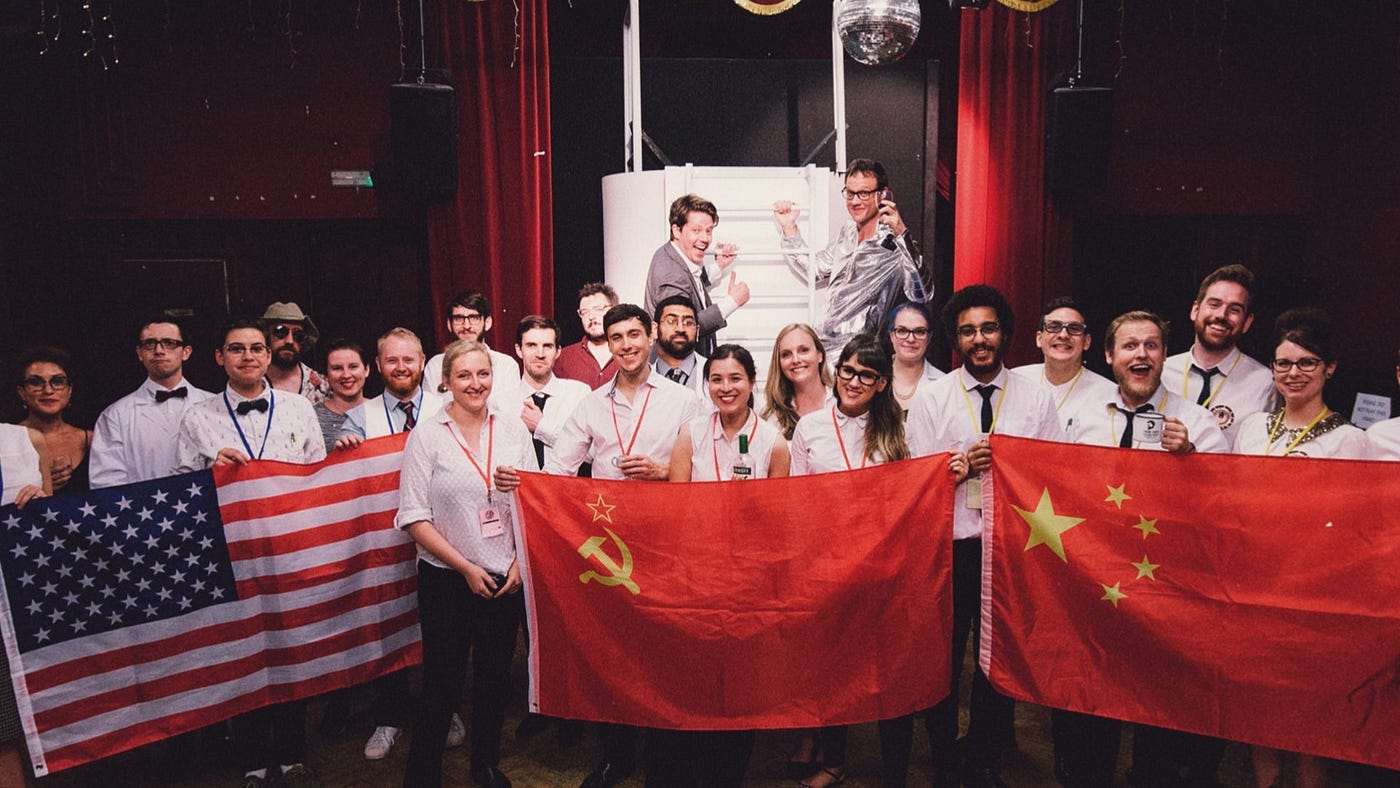
Site-generic and self-described as a “frenetic immersive game,” Bring Them Home is notably fast-paced with carefully structured rounds and a moderating staff ever-cognizant of its performance time limit. We never forget for an instant that we’re in a drafty warehouse space huddled around boards and tokens and notepads on trestle tables, with a team of facilitators advising us as to how best to strategize. While there is a loose narrative, the focus is entirely on making the smartest move to reach the immediate objective rather than experiencing the mise en scène of the production. The towering rocketship viewed at the start of the night with such hope for spectacle does not come into play at all, and besides our host’s suit and the facilitator’s white lab jackets there are no costumes, lighting changes, or other forms of theatricality apart from the script.
While it may be an exploration of the furthest reaches for the title of “immersive,” Bring Them Home is an excellent choice for budding roleplayers and fans of tabletop games to have a night out on the town. Attendees are able to do something a little different, meet new people, and enjoy an over-the-top strategy session with significantly more pomp and flair than the average living room hangout. I am disappointed the by liberal use of the “immersive” moniker in the VAULT festival lineup this year but in terms of audience agency Bring Them Home offers an atmosphere of interactivity that will hopefully send its trajectory toward the realm of standard installations at science museums and gameplay festivals for years to come.
Bring Them Home has concluded its run at the VAULT Festival. Learn more about the game’s creator, Treehouse.
NoPro is a labor of love made possible by our generous Patreon backers. Join them today!
In addition to the No Proscenium web site, our podcast, and our newsletters, you can find NoPro on Twitter, Facebook, YouTube, Instagram, in the Facebook community Everything Immersive, and on our Slack forum.
Office facilities provided by Thymele Arts, in Los Angeles, CA.


Discussion