



The weather is hatefully cold, just past sunset on a Thursday evening in London. March has announced itself with spiteful winds that howl down the tunnel beneath Waterloo Station, sending attendees of the Vault Festival scurrying indoors to the central cavernous reception hall. Usually when I’m headed to the Vaults I pass a handful of graffiti artists tagging the Leake Street art tunnel with fresh paint as flocks of smokers crowd the sidewalk next to the festival entrance, but not tonight. Tonight the only objective is to get inside.
My salvation from the cold is delayed, however, as it appears my performance is taking place in an annex location. I’m obliged to wait outdoors in a holding zone. We early arrivers patiently stamp our feet in an attempt to stay warm until finally an assistant leads us back down the tunnel and ushers us into Unit 9. This is a new space for the festival this year: an isolated cloister where the Vaults have sequestered several of their more fully interactive performances.
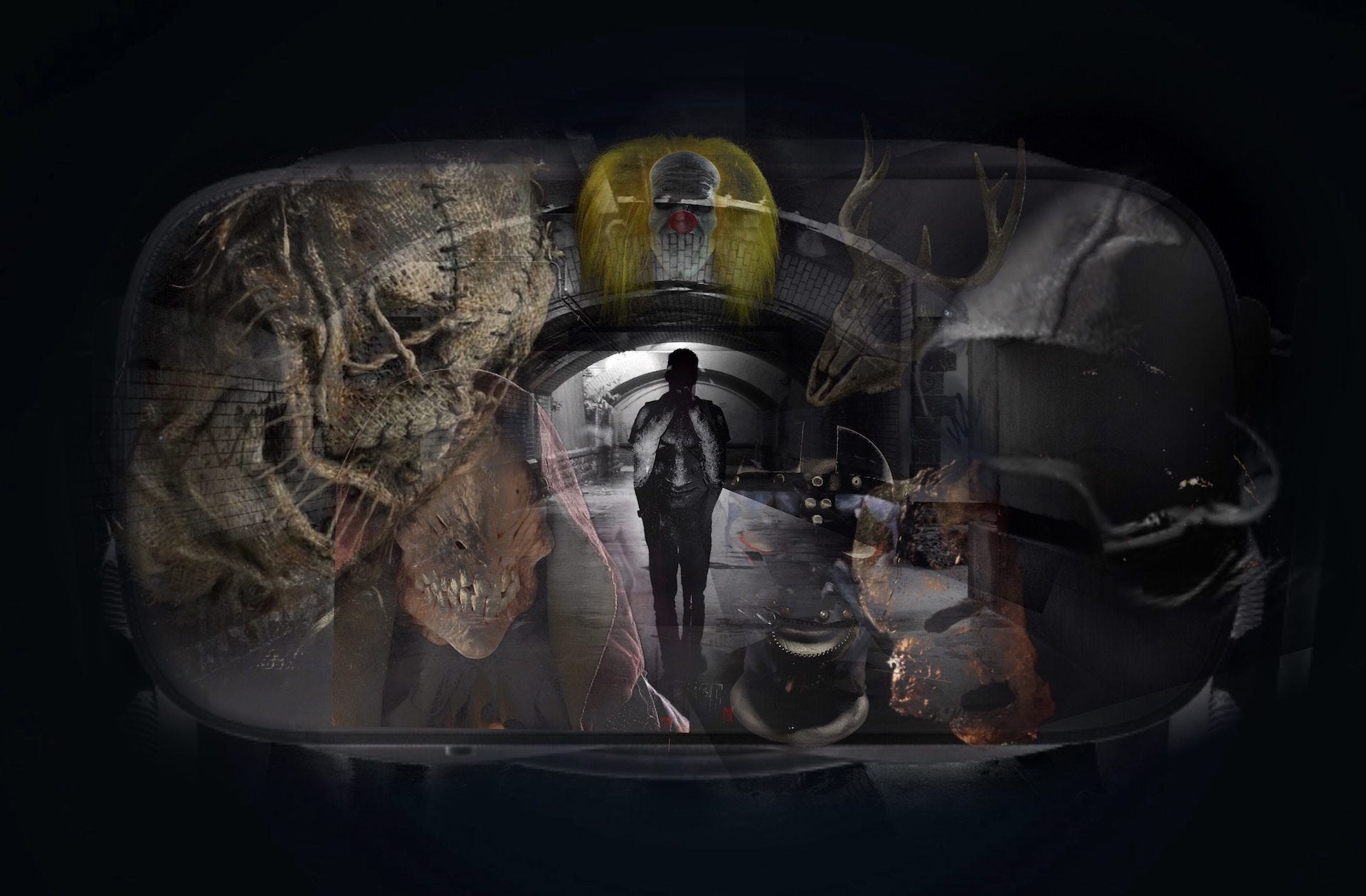
Developed by media production company The Tom Sawyer Effect, The Pendulum is advertised as a 15 minute long one-on-one immersive horror experience. I am a notorious scaredy-cat and usually wouldn’t be found within a hundred-foot radius of a haunted house. The wretched weather is only exacerbating the chill in my blood at the prospect of a personalized spook session. The promise of a one-on-one performance, however, is enough to cajole me to grit my teeth and plunge in; I can assure myself that I only need to last a quarter of an hour.
Upon entry I’m obliged to read and sign an information sheet that explains both the health & safety risks of the performance and the scenario, with a narrative-based code phrase that also doubles as a safe word. The Pendulum is pragmatically treating itself as an “extreme” experience, which feeds into the audience’s anticipation and develops a higher level of expectation. These briefings are commonplace in the more extreme haunted houses. Scare franchises like Blackout warn attendees how they will be touched and interacted with by performers and how visitors can use a predetermined safe word to halt their participation and allow them to be escorted out.
I step into an orange jumpsuit which distinguishes me as an agent of the resistance force and I’m handed a small plastic remote without much ceremony. I’m then instructed to sit in a chair and await collection; I feel a bit exposed as I’m sitting in full view of the check-in desk and can overhear discussion about the other performances going on in the space. It would have been preferable to be seated in an antechamber and left to fall into the mood of the narrative but it’s clear that The Pendulum is working with the environment they’ve been given.
Get Shelley Snyder’s stories in your inbox
Join Medium for free to get updates from this writer.
SubscribeSubscribe
I’m shortly greeted by an actor whose arrival and appearance is jarring in the aforementioned informal environment. His simmering aura of meticulous malice has been carefully curated to trigger all the fight-or-flight reactions a civilian woman may harbor. Once he’s zip-tied my wrists together and placed a semi-opaque hood over my head I no longer worry about losing the mood. Now I’m fully engaged in this tactile and kinesthetic experience. I am restrained, blindfolded, and left in an isolated warehouse cubby with a man I’ve never met.
The performance is half live-action and half virtual-reality, and the format flows back and forth fairly fluidly. After securing me to a heavy chair with restraints (loosely fit — these are merely for the sensation and I am at all times capable of freeing myself), my captor is responsible for applying and removing the headset as is required during the narrative. Throughout the experience I am regularly asked if I’ve had enough of my treatment and if I’m willing to give up the code word to be released. I’m given the opportunity to improvise discussion with the actor but contribution on my part is not necessary to advance the narrative. Indeed, the remote control I was handed at reception has no actual effect on the performance, though it is referenced as having control over the VR portion of the scenario and does serve as a physical prop to further immerse me. There are points during the VR experience that I choose not to seek out what’s happening around me (again, because I’m a ‘fraidy-weenie) but physical touch and scent stimuli are synchronized to the visual displays and provide disorienting sensations. Sound design plays an intrinsic role in the performance; much of the sound is delivered through the headset speakers but I find myself constantly straining to detect the real-word footfalls and breathing underneath that might herald the reappearance of my tormentor. The juxtaposed dissonance of sounds which the audience knows are simulated and those that are undeniably real is under-explored terrain in immersive performance. The Pendulum may do well to expound on this and further develop its own potential.
By the end of the experience I’ve built up a strong distrust of the characters. I’m even hesitant to trust my rescuer, suspecting he may be an agent of the opposition. This emotional hostility indicates the effectiveness of the performance. Within 15 minutes The Pendulum has cultivated a visceral reaction manifested (within the terms of the scenario) as an urge to hinder the enemy’s objective. The rescue sequence is over quickly, almost too quickly to properly emotionally detach from the realm of the show before being thrust back into the festival atmosphere. I’m disoriented as I prepare to leave, but as I bundle up to head home and step out of Unit 9 I feel the shaking in my extremities begin to calm. By the time I exit Leake Street my nerves are back to normal but I know I’ll be feeling the adrenaline high for the rest of the evening.
The Pendulum’s press release implies that different endings are possible depending on the choices made by the audience. Multiple endings are a successful marketing tactic to sell tickets to repeat guests, especially to those who are keen to discover how many endings there are and on which terms they may be accessed. I’m curious as to what would happen if a guest chooses to use the safe word, what form the story might take or if it continues at all. Does the performance come to a complete halt or does the performer offer an applicable narrative as the guest is escorted out of the performance? Are there consequences for distrusting the rescuer and failing to deliver what they’re seeking? How far can a confident audience member improvise conversation with their captor and further exercise their own agency?
Repeat visits may be necessary to see just how far in any direction The Pendulum can swing.
The Pendulum plays as part of London’s Vault Festival through March 18th. Tickets are £11.50.
No Proscenium is a labor of love made possible by our generous Patreon backers: join them today!
In addition to the No Proscenium web site, our podcast, and our newsletters, you can find NoPro on Twitter, Facebook, YouTube, Instagram, in our Facebook community Everything Immersive, and on our Slack forum.


Discussion