



This week our staff has prepared three substantial courses for you that will promenade you around DUMBO, lure you into a liminal space in North Hollywood, and invite you into Brooklyn town home.
Unusual theatre in unusual spaces, that's (one of) our (nineteen) motto(s) here.
Shall we?
NoPro is 100% reader & listener supported. Support our work by becoming a subscriber, which comes with access to our newsletter & Discord, or drop a one-time gift in the Tip Jar of any amount to share your love of immersive experiences.
Want more? Check out our most recent edition and our REVIEWS section.
Check out our How To Get Covered By NoPro guide to submit your events & experiences for review. Want the opportunity to get your work listed in our newsletter & socials? Submit a listing to Everything Immersive.
The Circuit (NYC)
New York Theatre Company
From $73 (lottery, rush, and artist tickets available); Brooklyn, NY; May 17 - July 31, 2026
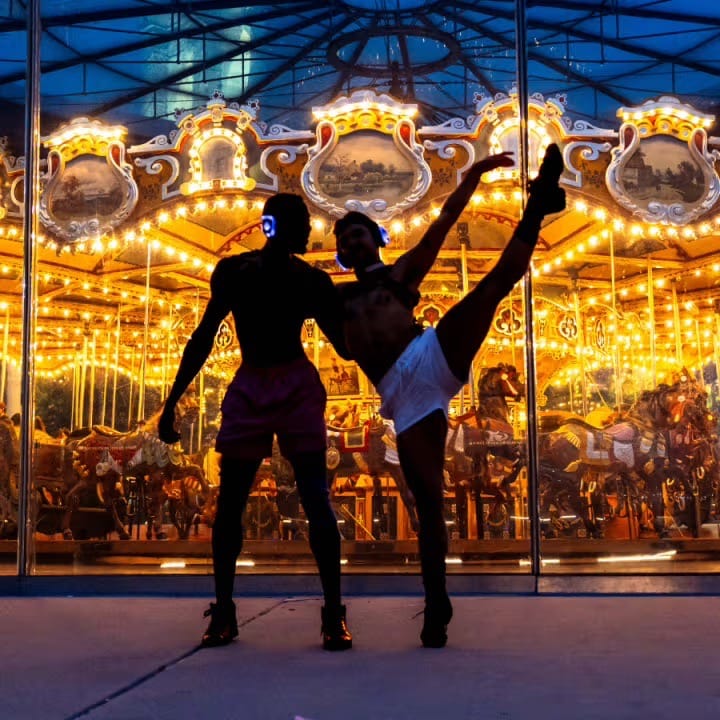
Inspired by Arthur Schnitzler’s incendiary late 1800s play La Ronde, The Circuit invites guests to an EDM-fueled “silent disco ballet” on the sidewalks and park paths of DUMBO.
Schnitzler’s notorious work followed a daisy chain of sexual interactions across socioeconomic classes. An interlocking script structure allowed the focus to follow each character for two consecutive scenes, revealing unexpected power dynamics and scandalous affairs that culminated as a loop.
In The Circuit, co-directors Josh Zacher and John Kroft borrow this format for a less specific perspective on modern intimacy. Guests don glowing headphones and follow staff through a series of La Ronde-ish vignettes, hearing a hybrid of each character’s inner and outer monologues as they seduce, evade, or clash with one another. The loop format is maintained by starting with a single performer, following them to a scene, and departing that scene with their scene partner. And so on, until we arrive back at the starting place. The overall experience is a voyeuristic showcase of sensual, modern dance.
The performers are sexy, their movement styles are varied and playful, and a couple settings offer sincere (if brief) moments of wonder. Spying on a couple dancing through a line of trees and fast-walking in parallel to a pas de deux, backlit by a glowing carousel, were particularly resonant sequences.
Writer Connor Wentworth’s script is largely constrained to open format, focusing on two-character interactions with minimal context and objective. The upside is this lets Zacher’s evocative choreography do most of the talking. The downside is the plot and characterizations are somewhat… threadbare. Lacking any overriding drama or discernible commentary on queer culture itself, the emotional impact falls flat. I left thinking, “If we are not part of the story, why are we here? What do these events have to teach us?”
This is not helped by the heavily peaking score/mix from sound designer Jacob Ryan Smith and associate Anna Tobin. Pre- and post-show music come in crystal clear, but gain levels mid-show leave half of the dialogue and bass in a mess of distracting static. It’s a shame, because Smith and Tobin’s solid creative work is the foundation. Hopefully, this proves fixable.
The Circuit is an entertaining guerilla dance concert, but hardcore fans of promenade and headphone theatre will be disappointed by its interactive/narrative limitations. For those willing to try nonetheless, my hot tip is to only enjoy this show after the sun sets. Its mood, and a few added effects, depend on darkness.
– Brandon Santoro, Guest Reviewer
The Shoebox Museum (Los Angeles)
DrownedOut Productions
$55-75; After Hours Theatre, North Hollywood, CA; June 26 - July 26
The latest from DrownedOut Productions is a left turn away from horror, that is unless you find the subject of break-ups traumatizing, but with the Jackson Mancuso led company taking solid steps forward with their strong suit of environmental storytelling.
The Shoebox Museum is framed as a place where the moments and memories of failed relationships are stored, namely “the little things we hold on to” and what they say about our past.
Up to two people at a time can visit the museum, and upon arrival you take a short quiz in order to determine which collection is the right one for you to experience. There’s actually only one story behind the curtain, but the frame makes for a good gear shift from waiting on the streets of North Hollywood before starting the journey into the fully transformed backstage area of the After Hours Theatre Company space.
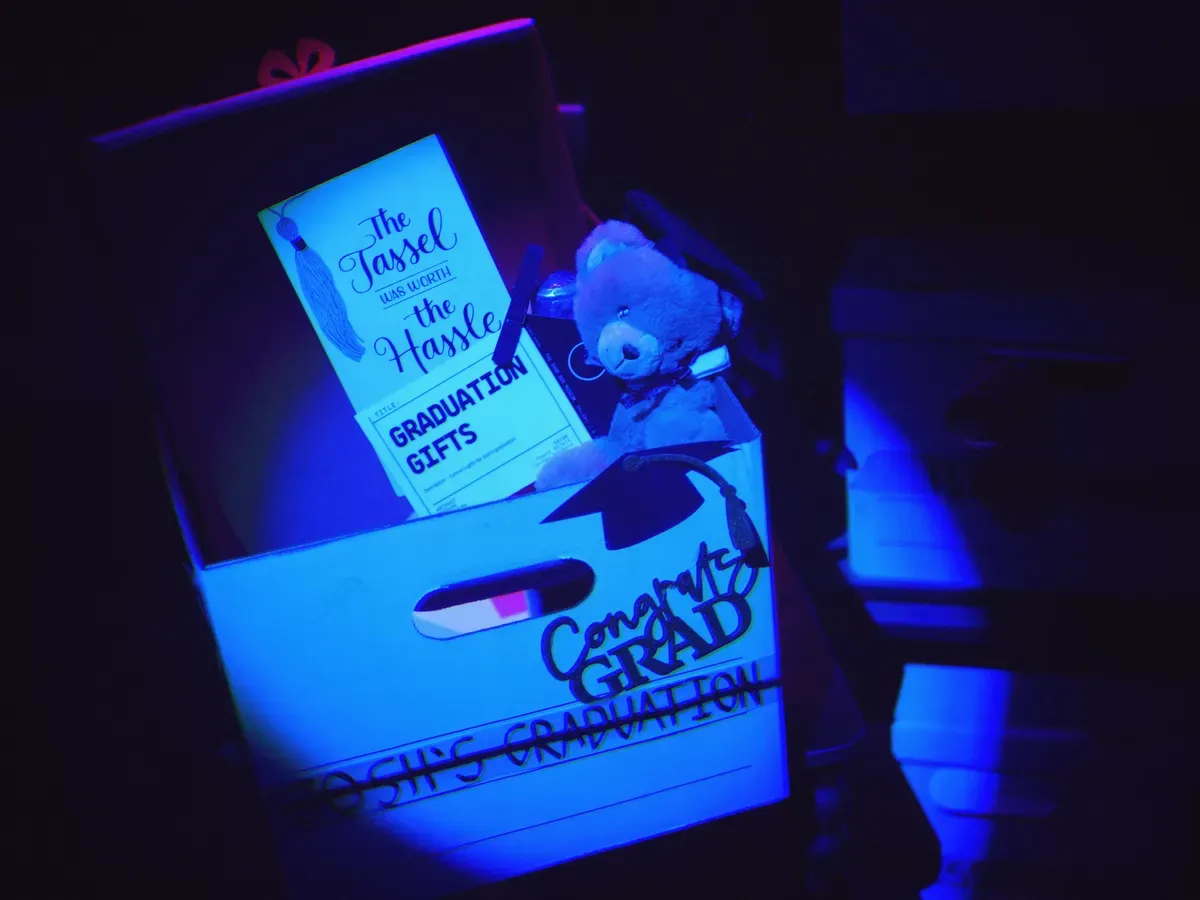
Before stepping beyond the curtain the Museum’s curator hands you a box and lets you know that some of the artifacts from this particular exhibit have gone missing, but that the Museum might just reveal a path to finding them.
What follows is a small scale technical wonder of show control and cueing that really shows off what’s possible when a talented team of designers with theatrical and theme park experience unleash themselves on telling human scale stories.
The first room is an eerie collection of artifacts hanging from cords: pluck an artifact and the lighting shifts and an audio memory from the relationship starts playing. Not in headphones, mind you, but in hidden speakers, creating a communal experiencing if you’ve come with someone.
Interact with one of the red card missing artifact tags and the air fills with static. There is no preset path here, you pick the artifacts in any order but seemingly one will interact with them all before moving on.
Past that room the real journey begins, as beyond the “gallery” are the storage area of the Museum where the lost artifacts wait to be discovered. Indeed their emotional contents have spilled out onto the surfaces of the storage area, and while the “pluck a string” mechanic remains the production design ratchets up by several degrees.
I want to stop for a second here to admire just how fully the DrownedOut team transformed this space. I know the After Hours backstage area nearly as well as I know my own kitchen at this rate and I’m still not entirely sure I could map out the layout of the set. Just incredible work.
Where The Shoebox Museum could use some work is in the pacing of the storytelling. Not enough opportunities are taken to get us to fall in love with the characters whose breakup we’re exploring. My exploration partner for the night, who has more than a little familiarity with this genre of storytelling, thought it could use two beats more in that department. I think they could get it in one. In either case, we left wanting more of the sweet before we got the bitter.
In any case, The Shoebox Museum is worth visiting if this kind of story — from The Nest to Gone Home — is your jam. If you’ve enjoyed DrownedOut’s previous works Limos and People in the Dark you just might be surprised by how well the company’s style translates out of the horror genre.
—Noah J. Nelson, Publisher
Tempest Tossed (NYC)
New Place Players
$44.52; Casa Duse in Brooklyn, NY; June 4-26
As a critic for No Proscenium, it’s my responsibility to start this review with a disclaimer, expressed best by my plus one, Nate Cuevas, as we left the theater: “This show wasn’t immersive, but it was intimate.”
Yet through this intimacy, emerged both 1) an interesting reimagining of Shakespeare’s The Tempest, well-acted and well-scored with haunting chamber music and 2) a contemporary revival of Victorian drawing room theater with immersive implications.
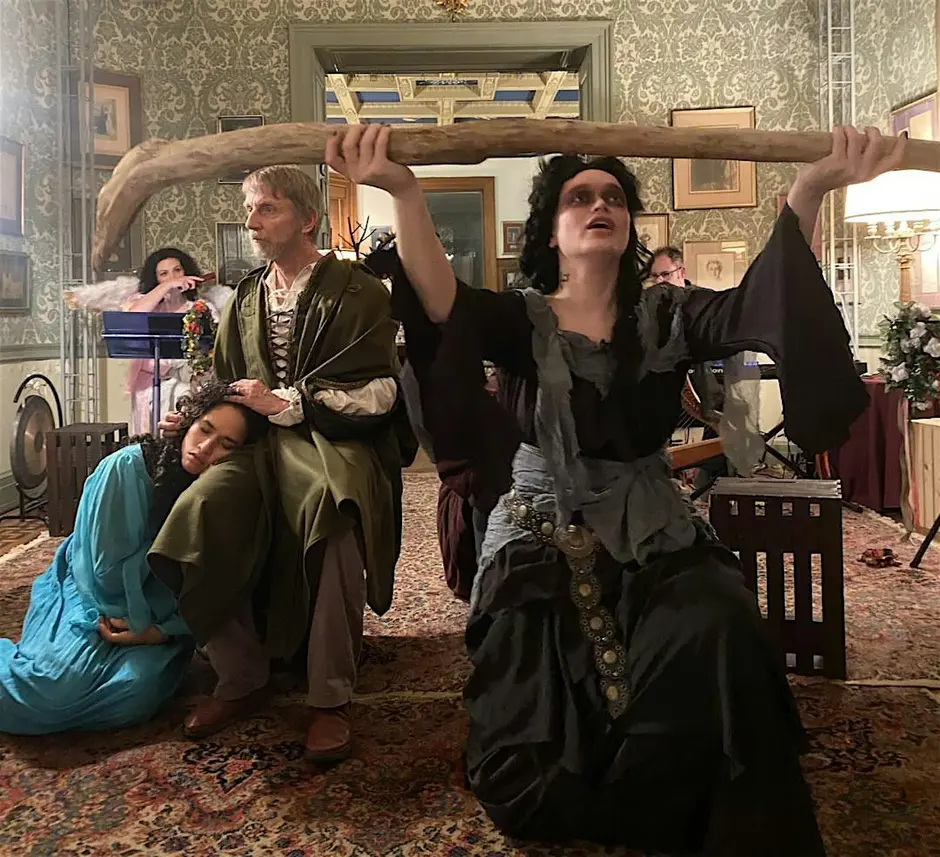
For all intents and purposes, New Place Players’ production was a traditional proscenium show. We sat and watched the actors perform on a stage without audience interaction in a location that didn’t connect to the story—at least not obviously.
The production was put up in a Brooklyn town home, one that boasts a sparkly history of performance and opera. The back room, or shall I say parlor, is filled with signed portraits of famous actors like Charlie Chaplin, Laurence Olivier, and Joan Sutherland, as well as other relics of entertainment history. The experience begins with a pre-show reception of sorts here, including food and drink and time to amble about looking at the historic, homey decor.
As the show began, I was curious to see if, dramaturgically, the text had been reimagined at all to make the show site-specific: Would this production of The Tempest take place in a town home? As far as I could tell, it didn’t. This was a traditional, albeit delightful, performance of Shakespeare that just so happened to also be in a town home.
It reminded me of Victorian-era parties, in which hosts might put on a domestic performance in their drawing room to delight their guests after meals.
Then I remembered Act III of Hamlet, and couldn’t help but think of the very Shakespearean trope of actors putting on a show within a show, as plot devices and commentaries on the medium. At the risk of overly academizing, I wondered if this production was a self-contained performance of The Tempest? Or was it a meta narrative, both referencing and repeating the tradition of domestic performances? If that’s the case, were the actors all playing actors putting on a show, and were we, by extension, playing guests watching their show? Had I become a modern-day member of Victorian polite society? Suddenly, I found myself sitting up straighter, clapping more gracefully, holding my wine glass a bit more delicately.
(Of course, to take a Butlerian approach, theater’s own special social expectations always demand a certain performance of audienceness from its audience. We are trained to sit, clap, ooh and ahh in a certain way, compliant with those expectations. So, at some level, we are always asked to participate as a character in productions. Now, does this make all theatre immersive? Hell no.)
Yet, against the Manhattan grain of commercial theater (which, to be clear, I also adore), the charmed refinements of entering a brownstone beside Prospect Park, indulging in a complimentary glass of wine and a smattering of canapés, and watching some Shakespeare might just be enough to immerse guests in a different era of performance.
Tempest Tossed might not have been immersive. But maybe, through its hyper-intimacy, the New Place Players experience, as an exploration, commentary, and continuation of the Victorian parlor show, was. All the world’s a stage, etc.
–Alec Zbornak, NYC Correspondent
Discover the latest immersive events, festivals, workshops, and more at our new site EVERYTHING IMMERSIVE, home of NoPro’s show listings.
NoPro is a labor of love made possible by our backers. Join them today and get access to our Newsletter and Discord!
In addition to the No Proscenium website and our podcast, and you can find NoPro on Bluesky, Facebook, LinkedIn, YouTube, Instagram, and in the Facebook community also named Everything Immersive.


Discussion